Great Lakes - PGDM & PGPM Admissions 2027
Globally Recognized by AACSB (US) & AMBA (UK) | 18 LPA Avg. CTC for PGPM 2026


We're back with the strategy for Day 13 of our CAT 2024 preparation. Today, we'll focus on tackling CAT algebra questions. Stick to our 60-day CAT exam preparation schedule to maintain a steady flow, plan, and structure for your studies.
This Story also Contains
Linear Equations is an important part of Algebra as well as for the CAT exam. You can expect 1 or 2 algebra questions for the CAT Exam.
Linear equations are mathematical statements which are used to find the value of some unknown variable(s). Graphically linear equations always form a straight-line curve.
A linear equation is an algebraic equation in which each term is either a constant or the product of a constant and a single variable.
Linear Equations can have one or more variables.
The general form of a linear equation is based on the variables.
Linear Equations in One Variables : ax + b = 0 a ≠ 0 and x is the variable.
Linear Equations in Two Variables : ax + by + c = 0 a ≠ 0, b ≠ 0, x and y are the variables.
Linear Equation in three variables: ax + by + cz + d = 0 a ≠ 0, b ≠ 0, c ≠ 0, x, y, z are the variables.
Slope intercept form: y = mx + b; m = slope of the line b = y-intercept
Point Slope form: (y - y1) = m(x - x1)
To Solve Linear Equations, the Number of variables cannot be greater than the number of equations.
CAT linear equation questions can be categorised into the following types:
Questions that involve calculations of some unknown variables.
CAT linear arrangement questions that involve calculations of the number of solutions/ Types of solutions.
Methods of solving Linear Equations:
Method of Substitution: It involves picking one equation from the pair of linear equations in two variables and writing one variable in terms of the other. Then substitute that value in the other equation.
Elimination Method: It involves adding or subtracting the equations to eliminate one of the variables, making it possible to solve for the remaining variable.
Graphical Method: This method visually shows the solution to a pair of linear equations by plotting the lines and finding their intersection point.
Question 1. When you reverse the digits of the number 13, the number increases by 18. How many other two-digit numbers increase by 18 when their digits are reversed?
[CAT Question Paper 2013]
7
5
6 (Correct answer)
8
Solution:
Let the number be (10a + b), so when the digits of the number are reversed, the number becomes (10b + a).
According the question, (10b + a) – (10a + b) = 18
⇒ 9 (b – a) = 18
⇒ b – a = 2
So, the possible pairs of (x, y) are
(1, 3), (2, 4), (3, 5), (4, 6), (5, 7), (6, 8), and (7, 9).
13 is already there, so other possible numbers are 24, 35, 46, 57, 68, and 79.
So, the total number of possible numbers (except 13) is 6.
Question 2. Let k be a constant. The equations kx + y = 3 and 4x + ky = 4 have a unique solution if and only if [CAT Question Paper 2020]
k ≠ 2
|k| = 2
k = 2
|k| ≠ 2 (Correct answer)
Solution:
For a unique solution,
a1/ a2 ≠ b1/ b2
⇒ k / 4 ≠ 1 / k
⇒ k2 ≠ 4
⇒ |k| ≠ 2
Question 3. The cost of 12 apples and 15 oranges is INR 660. The cost of 15 apples and 21 oranges is INR 870. Find the cost of one apple.
INR 25
INR 15
INR 30
INR 20
Solution:
Let the cost of one apple be x and one orange is y.
According to the question,
12x + 15y = 660 .......(1)
And, 15x + 21y = 870 ........(2)
Multiplying equation (1) by 5 and equation (2) by 4, we get,
60x + 75y = 3300 and 60x + 84y = 3480
Subtracting these equations, we get,
75y - 84y = 3300 - 3480
⇒ 9y = 180
⇒ y = 20
Putting this value in (1), we get,
12x + 15(20) = 660
⇒ 12x + 300 = 660
⇒ 12x = 360
⇒ x = 30
Hence, the correct answer is INR 30.
Question 4. The cost of 3 pieces of bread and 1 packet of juice at a certain store is Rs. 323.50. At the same store, the cost of 5 pieces of bread and 1 packet of juice is Rs. 433.50. What will be the cost of 2 pieces of bread and 2 packets of juice at this store?
Rs. 427
Rs. 350
Rs. 403
Rs. 433
Solution:
Let the cost of one bread be b and the cost of one packet of juice be j.
The cost of 3 breads and 1 packet of juice.
⇒ 3b + j = 323.50---(1)
The cost of 5 breads and 1 packet of juice.
⇒ 5b + j = 433.50---(2)
Subtracting the first equation from the second,
⇒ 2b = 433.50 - 323.50 = 110
⇒ b = 110/2 = 55
Substituting b = 55 into the first equation,
⇒ 3 × 55 + j = 323.50
⇒ j = 323.50 - 165 = 158.50
So, the cost of one bread is Rs. 55 and the cost of one packet of juice is Rs. 158.50.
Therefore, the cost of 2 breads and 2 packets of juice is,
⇒ 2b + 2j = 2 × 55 + 2 × 158.50 = 110 + 317 = 427
Hence, the correct answer is Rs. 427.
For this topic, students must have knowledge of the following while preparing through Algebra practice questions:
Speed Maths/ Vedic Maths.
Unitary Method
Variables and constants.
Use the Elimination method by making the coefficient of one variable equal in two equations.
See the solution either as consistent or inconsistent.
If two lines intersect exactly at one point, then the system of equations has only one Unique solution.
If two lines coincide or stay on the same line and overlap completely, then the system of equations has infinitely many solutions.
If two lines are parallel and never intersect each other, then the system of equations has no solution. In this case, the slopes of the two lines are the same but their intercepts are different.
If a1x + b1y + c1 = 0 and a2 x + b2y + c2 = 0 are two linear equations,
Then,
a1 / a2 ≠ b1/ b2 to have a unique solution.
a1/ a2 = b1/ b2 = c1/ c2 to have to have infinitely many solutions.
a1/ a2 = b1/ b2 ≠ c1/ c2 to have no solution.
References to Study (Theory):
NCERT Class 9-10
Quantitative Aptitude for CAT by N K Sinha
2iim (You-Tube)
References to Study (Practice) CAT Algebra Questions:
Quantum CAT by S K Verma
https://iim-cat-questions-answers.2iim.com
Previous Year's Question Papers
Direction Sense Consists of the following types of questions in CAT:
To Find the direction of a person after taking some turns from its initial position.
To find the distance between the initial and final position.
Questions on Shadow.
Questions on the direction of the hands of the clock.
Basic Directions
Test centres are available in 70+ cities across India | 75,000+ aspirants apply for the NMAT exam | Accepted by 58+ institutions like NMIMS, KJSIM, ISB, SPJIMR and Great Lakes.
AACSB Accredited | 40 LPA-Highest CTC | Scholarships worth 10 CR
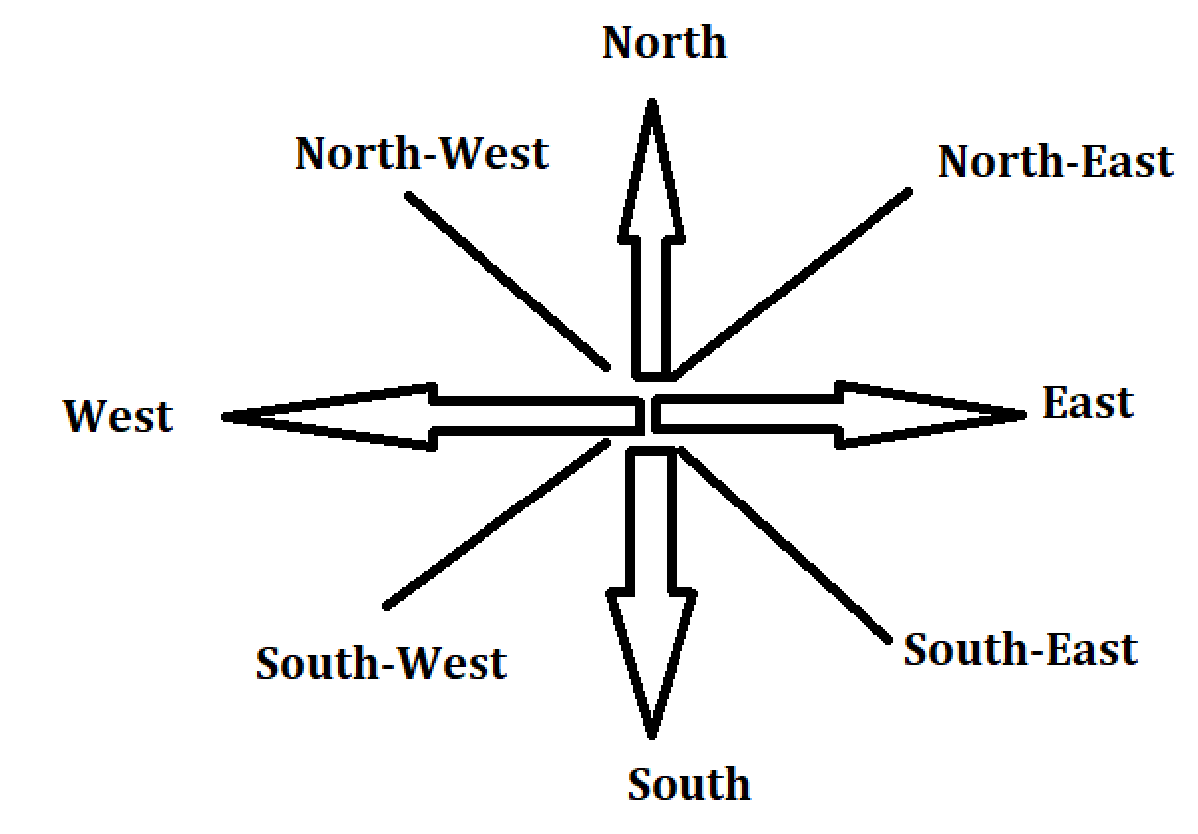
Concept of Shadow
Facing of a Person | Direction of Shadow (Morning) | Direction of Shadow (Evening) |
North | West | East |
East | West | East |
South | East | West |
West | East | West |
3. Distance between initial and final positions will be calculated by using Pythagoras theorem.
Direction Senses test tricks:
Draw a direction diagram.
You can count the number of rotations to find the final direction with respect to the initial direction
1 Right turn = 3 left turns = to the right of initial direction
2 Right turns = 2 left turns = to the opposite of initial direction
3 Right turns = 1 left turn = to the left of initial direction
4 Right turns = 4 left turns = in the same direction of initial direction
3. (Hypotenuse)2 = (Base)2 + (Perpendicular)2 (For right triangle)
4. Draw the distances in proportion while drawing a distance diagram.
Now we have to practise some direction sense aptitude questions, direction sense test questions pdf, and direction sense test MCQ to have a better understanding of this concept.
Question 1. Raju, a child labourer is looking for his uncle. He went 60 metres in the West before turning to his left. He went 20 metres before turning to his right again to look for his uncle at his home 30 metres from this point. His uncle was not there. From here he went 60 metres to the South before meeting his uncle at a grocery shop. What is the smallest distance between the starting point and his uncle’s position (nearest to its integer value)? [TITA]
Solution:
For such questions, always remember that when a person moves to his left side, he will move in anti- clockwise direction and when a person moves to his right side, he will move in a clockwise direction.
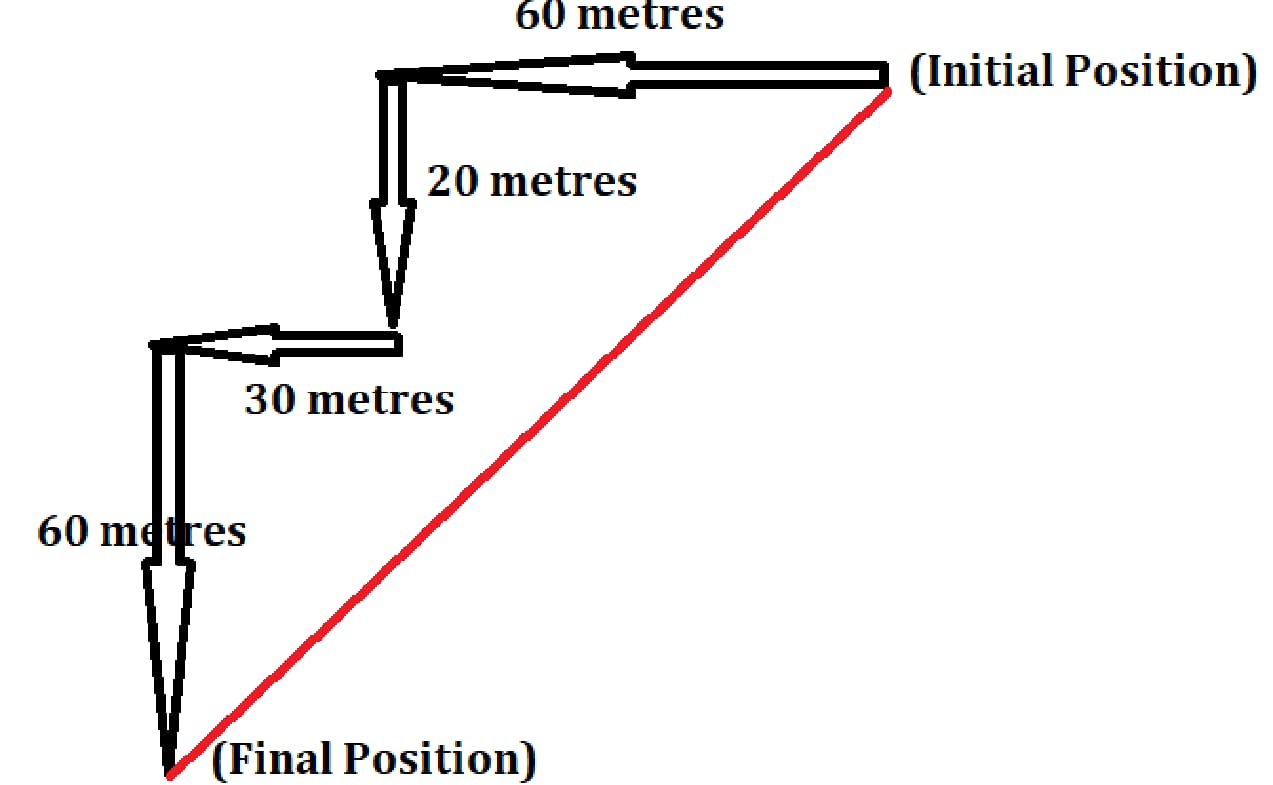
Vertical distance = 20 + 60 = 80 metres
Horizontal distance = 30 + 60 = 90 metres
Distance between initial and final position= 802 + 902 = √14500 = 120 m (Approx)
Question 2. A is in the West of B which is in the north of C. If P is in the south of A, then in which direction of B, is P?
North-East
West
South
South- West
Solution: (D)
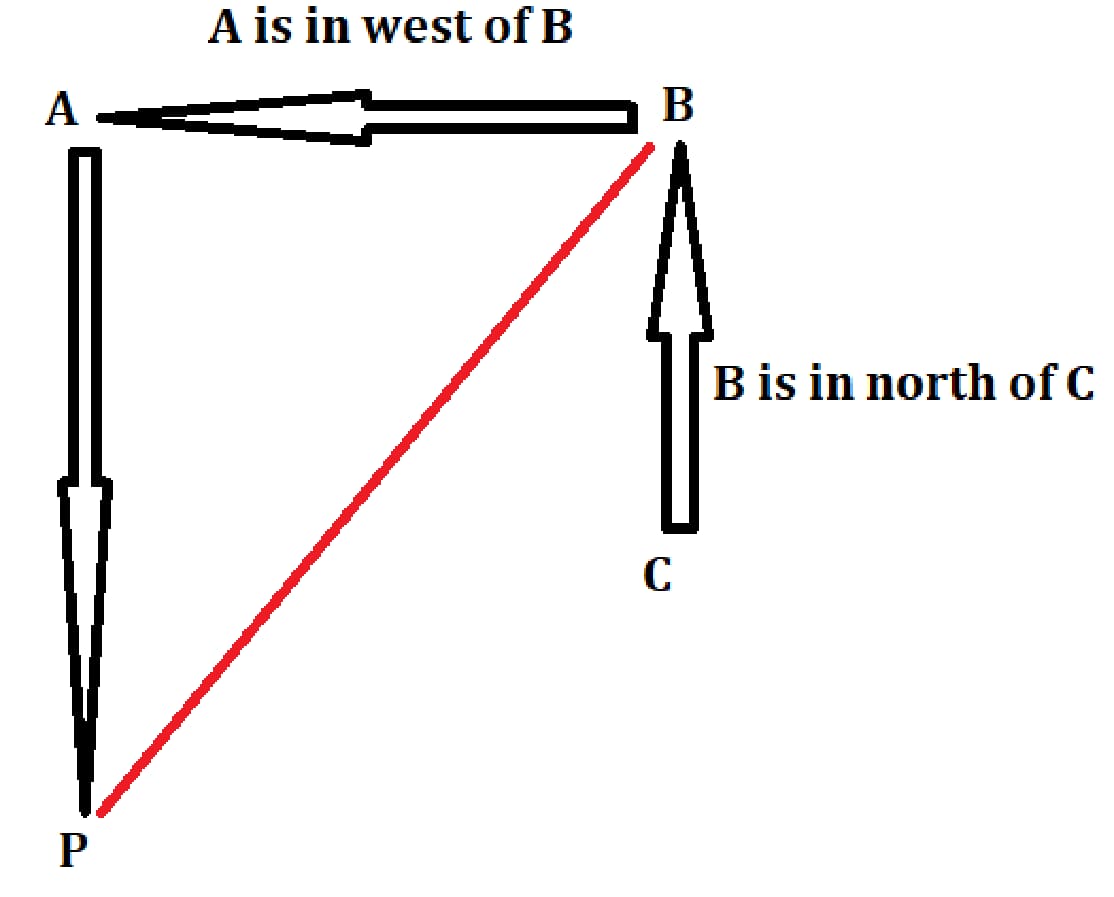
P is in the south-west of B. (Even P can be anywhere in the line above it)
To Prepare the questions based on direction sense, a student must have the knowledge of
Knowledge of basic direction
Pythagoras theorem
References to Study (Theory):
A New Approach to Reasoning by B.S. Sijwali & S. Sijwali Arihant
wifistudy (YouTube Channel)
References to Study (Practice):
Verbal and Non-Verbal Reasoning by R S Aggarwal. (Basic)
LRDI for CAT and GMAT by Nishit K Sinha. (Advance)
Previous Year's Question Papers
As discussed in the previous two articles, tenses are divided into three types. Today we are going to discuss the future Tense and future tense formulas.
Future Tense: Future tense is used to describe the event that will have to occur in the coming time.
Future tense can further be divided into four categories to indicate the action as follows:
Simple Future Tense/ Future Indefinite Tense: denotes habitual action in the coming time. The action is supposed to be finished in the future but its time is not definite.
Formula: Subject + Will + Verb(present form) + Object
Example: Geetha will go abroad to study.
Future Perfect Tense: it refers to an action that will have to be completed on a later date or day but its time is known.
Formula: Subject + Will be + Verb(Present participle) + Object
Example: Geetha will have reached Delhi by next week.
Future Continuous Tense: denotes an action that will be in progress in the future.
Formula: Subject + Will have + Verb(Past participle) + Object
Example: Geetha will be coming to us in the next hour.
Future Perfect Continuous Tense: denotes an action that is under work or incomplete but will be finished in the coming time.
Formula: Subject + Will have been + Verb(Present participle) + Object
Example: Geetha will have been here by next week.
Students can make a past present future tense chart or practice on the simple future tense worksheet to understand it better.
Also, read simple future tense formulas and simple future tense examples to know better.
Question 1. Mother dolphins whistle to their calves frequently after birth so that the calves will learn to recognize their distinctive whistle. [Sentece correction]
[Previous Year Question]
learn to recognise their distinctive whistle.
learn to recognise their distinctive whistle.
will learn to recognise their distinctive whistle.
learn to recognise their mother's distinctive whistle.
Solution: (d)
Simple present tense for the verb ‘learn’ should be used in place of future verb ‘will learn’ as the verb ‘whistle’ used in the main clause is in simple present tense.
Question 2. By the end of this year, she_______worked for AJ production house for eighteen years. [Fill in the blanks]
Will work
Had been working
Will have been working
Will be working
Solution: (c)
Future perfect continuous tense should be used since work will be completed in the coming time and work is underway.
Basic Knowledge of Nouns, Pronouns and Verbs.
Basic knowledge of subject-verb agreement.
Knowledge of the use of helping verbs (Will/Will be/ Shall be/ Will have/ Shall have/Will have been)
Learn the rules of all types of future tenses.
Do basic exercises on Future tense.
Try to make new sentences by yourself.
Attempt Mock-Tests.
References to Study (Theory):
Advanced English Grammar by Martin Hewings
Learn English with Rebecca · engVid (YouTube Channel)
References to Study (Practice):
Purdue Online Writing Lab
How to Prepare for Verbal Ability & Reading Comprehension for CAT by Meenakshi Upadhyay and Arun Sharma (9th Edition)
Practise Sample Question Papers.
CAT 2024 GD PI Preparation: Experts and Toppers Tips | MBA Exams Computer Based Mock Test 2024 - CAT, MAT, XAT, SNAP, NMAT |
We will be back with Day 14 tomorrow. Do practice and be focused.
Thank You
All the best.

On Question asked by student community
Hello Student,
With a CAT 2025 percentile of 98.25, you have a good chance of receiving calls from several IIMs, particularly newer IIMs. However, IIM Ahmedabad , Bangalore , Calcutta , and Lucknow generally require higher percentiles for General-category candidates. Calls also depend on sectional percentiles, academics, work experience, and
Hello Aspirant,
Yes, you can access CAT preparation resources, including mock tests, practice questions, previous-year papers, and study material. Explore the CAT preparation resources and test series using the link below:
https://bschool.careers360.com/download/ebooks-and-sample-papers?exam=45
Hope this Helps!
Hello CAT Aspirant!
If you mean the CAT ( Common Admission Test) EWS certificate, the important point is whether the certificate is valid and issued in the prescribed format, rather than simply the language used on it.
Yes, a Hindi EWS certificate can generally be accepted for CAT, provided it
If you have already received your final MA result and have technically completed the degree , but you are only waiting for the revaluation outcome, you would generally be considered a graduate rather than someone whose master's degree is still completely in progress. However, CAT has specific instructions about qualification
Directions for question:
The bar-graph given below shows the foreign exchange reserves of Nepal (in million Rupees) from 2014 to 2021. Answer the following questions based on the graph :

Question:
What was the percentage increase (rounded to the nearest integer, if deemed necessary) in the foreign exchange reserves in

Globally Recognized by AACSB (US) & AMBA (UK) | 18 LPA Avg. CTC for PGPM 2026
75+ years of legacy | #1 Entrance Exam | Score accepted by 250+ BSchools
6-Hour Masterclass to help you score 99+ percentile in CAT 2026
Test centres are available in 70+ cities across India | 75,000+ aspirants apply for the NMAT exam | Accepted by 58+ institutions like NMIMS, KJSIM, ISB, SPJIMR and Great Lakes.
Registration Start: 3 August 2026 | Last Date to Apply: 15 September 2026 (till 5 PM)
AACSB Accredited | 40 LPA-Highest CTC | Scholarships worth 10 CR