NMAT by GMAC 2026
Test centres are available in 70+ cities across India | 75,000+ aspirants apply for the NMAT exam | Accepted by 58+ institutions like NMIMS, KJSIM, ISB, SPJIMR and Great Lakes.


For SET BBA 2027 aspirants, the strategy for SET 2027 preparation includes concept clarity, speed, and accuracy with regular practice. The SET General exam tests the candidates’ knowledge of General English, Quantitative Aptitude, General Awareness, and Analytical & Logical Reasoning. As per the SET 2026 pattern, candidates need to attempt 60 questions in 60 minutes with no negative marking.

Before starting your preparation, it is essential to know the SET BBA 2027 syllabus and the time required to finish each section. As per SET BBA 2026 exam pattern notification, the SET exam consists of four compulsory sections given below:
*Section | Questions | Marks |
General English | 16 | 16 |
16 | 16 | |
General Awareness | 16 | 16 |
Analytical & Logical Reasoning | 12 | 12 |
Total | 60 | 60 |
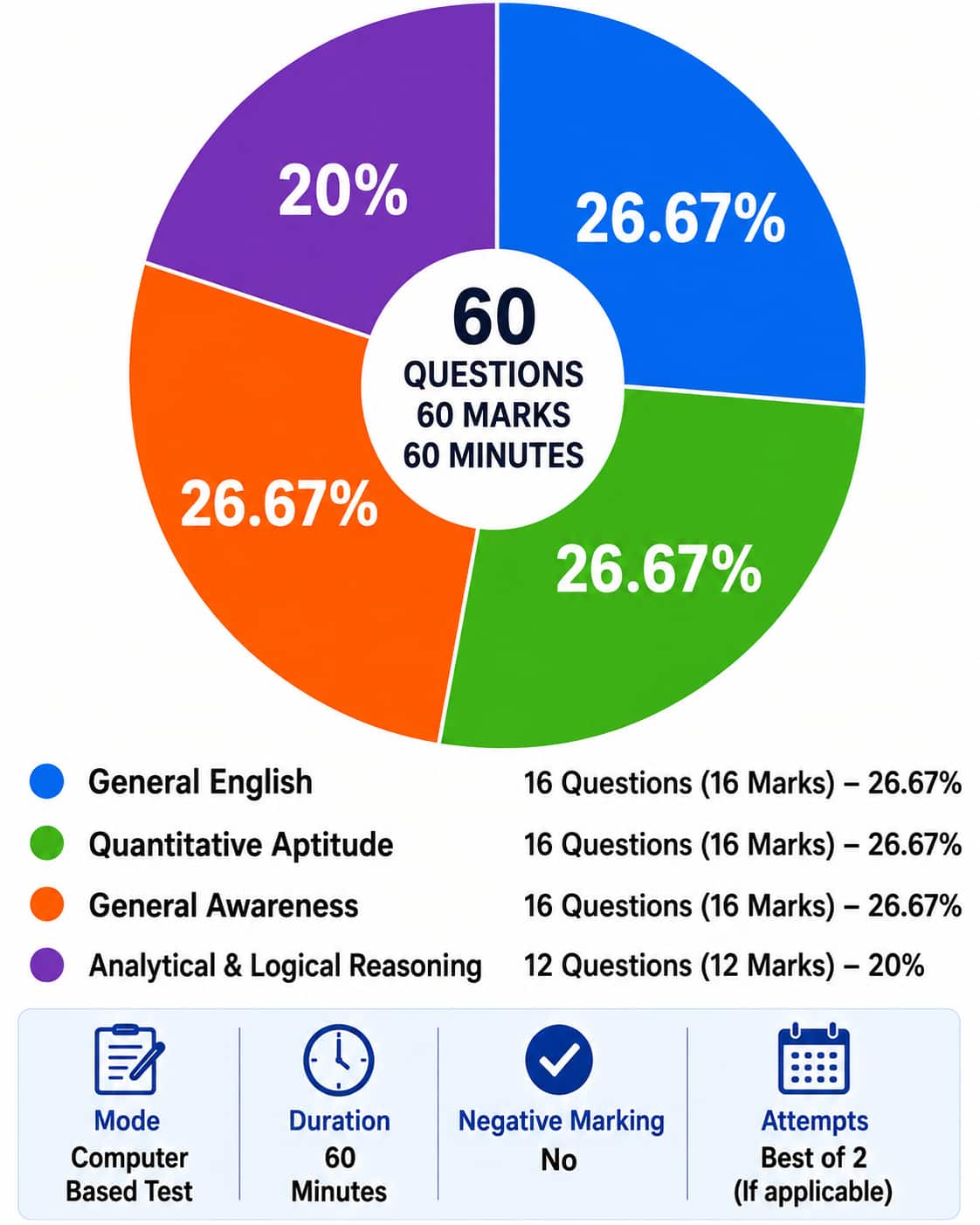
Thus, the SET exam lasts 1 hour, with 1 mark for each correct response. There was no negative marking for wrong responses. In addition, the candidate may appear for the exam twice; the best of the two scores will be considered.
Note: The SET BBA 2027 notification is yet to be released; therefore, the exam pattern, dates, and eligibility criteria may vary. [Official: https://www.set-test.org/]
Get a section-wise SET BBA 2027 preparation strategy covering English, Quantitative Aptitude, General Awareness, and Logical Reasoning, with practical tips to improve accuracy, speed, and overall performance.
General English consists of 16 questions. For SET preparation, candidates should focus on Reading Comprehension, grammar, vocabulary, and sentence correction.
Focus on:
Reading comprehension
Vocabulary
Synonyms and antonyms
Grammar
Sentence correction
Fill-in-the-blanks
Parts of speech
Tenses
Best strategy: Read for 20 - 30 minutes and then solve a few English questions within a fixed time limit. Keep a vocabulary notebook to note down new words, learn a few every day, and regularly revise the words you have already learned.
You don’t need to start preparing for quantitative aptitude by solving the toughest questions. First, focus on building concepts and then move to timed practice.
Topic | Priority |
High | |
High | |
High | |
High | |
High | |
High | |
High | |
Algebra | Medium-High |
Medium-High | |
Geometry | Medium |
Do not get stuck too long on topics that you understand very well. Concentrate mainly on topics that you tend to make mistakes on most of the time. After learning the basics, solve mixed sets of questions to know how to choose the right questions and to develop speed too.
Don’t leave general awareness for the last month. It is essential to develop a daily reading habit to stay updated.
Prioritise:
Business and economy
National and international events
Awards and honours
Sports
Important appointments
Government initiatives
Books and authors
Important organisations
Major national and global developments
Test centres are available in 70+ cities across India | 75,000+ aspirants apply for the NMAT exam | Accepted by 58+ institutions like NMIMS, KJSIM, ISB, SPJIMR and Great Lakes.
Registration Start: 3 August 2026 | Last Date to Apply: 15 September 2026 (till 5 PM)
Rather than studying current affairs for a couple of hours weekly, try spending just 20-30 mins per day and reviewing your notes over the weekend.
Reasoning is as much about pattern observation as it is about formulae.
These are the main topics that you need to practise:
Logical deductions
First, practise these questions without any time limit. Once you are comfortable with the type of questions, start taking sectional tests and reduce the time you take to answer them. The SET exam guidance also suggests that you improve your speed and accuracy by practising regularly.
You can follow this three-month SET BBA preparation plan, progressing from building basic concepts to practising exam-level questions and taking mock tests.
Month | Main Objective | What to Do |
Month 1 | Build Fundamentals | Complete core concepts and basic questions |
Month 2 | Increase Practice | Solve sectional tests and mixed sets |
Month 3 | Exam Preparation | Take mocks, analyse errors and revise |
Complete the basic concepts of Quantitative Aptitude, English and Reasoning. Start preparing for General Awareness from day one.
Do not try to solve each question in a hurry. At the beginning, accuracy is more important than speed.
Practice more questions every day and start section-wise tests; analyse which area you need to focus on.
Keep an error log with the following three categories:
Conceptual mistakes
Calculation or comprehension mistakes
Time-management mistakes
Get Real CAT-like Experience | Attend Mock Test on 26th & 27th September 2026 | Timings: 8:30 AM | 12:30 PM | 4:30 PM
Recognized as Category-1 Deemed to be University by UGC | 41,000 + Alumni Imprints Globally | Students from over 20+ countries
Take full-length SET mocks regularly under the pressure of stipulated time. Analyse your performance wherein you can note down the following:
Questions you left unanswered
Questions that took too long
Repeated mistakes
Sections where accuracy dropped
Topics that need revision
If you have to prepare for the SET entrance while studying in school/college, then 2-4 hours of focused practice every day would be a feasible plan.
A sample schedule could look like this:
Activity | Daily Time |
Quantitative Aptitude | 60 minutes |
General English | 40 minutes |
Logical Reasoning | 40 minutes |
General Awareness | 30 minutes |
Revision/Error Analysis | 20 minutes |
Total | 3 hours 10 minutes |
If you have weak fundamentals, increase the time spent on concept building. If your concepts are already strong, shift more time towards timed practice and mocks.
Taking mocks is important, but mock analysis is where much of the improvement happens.
After each test, ask:
Why did I get this question wrong?
Did I know the concept?
Did I misread the question?
Did I spend too much time?
Could I have skipped the question earlier?
Create a list of your five most frequent mistakes and review them before your next mock. This creates a continuous improvement cycle instead of simply collecting mock-test scores.
Avoid common preparation mistakes such as ignoring weaker sections, skipping mock-test analysis, neglecting General Awareness, and practising without time limits. Knowing these pitfalls early can help you make your SET BBA 2027 preparation more focused and effective.
All four sections were mandatory in the latest official pattern, so completely neglecting one area can limit your score.
SET gives you only 60 minutes for 60 questions. Regular timed practice is therefore essential.
Current affairs require repeated revision. Starting early reduces last-minute pressure.
A mock test should reveal your weaknesses. If you simply check the score and move to the next test, you lose much of its value.
Choosing the right books can help you build concepts, practise exam-level questions, and improve speed. The following books cover the major areas relevant to SET BBA preparation.
Book | Author/Publisher | Best For |
SET General Preparation Guide | Arihant Experts | Overall SET BBA preparation |
How to Prepare for Quantitative Aptitude for CAT | Arun Sharma | Quantitative Aptitude concepts and practice |
Quantitative Aptitude for Competitive Examinations | R.S. Aggarwal | Quant basics and extensive practice |
A Modern Approach to Verbal & Non-Verbal Reasoning | R.S. Aggarwal | Logical and analytical reasoning |
Word Power Made Easy | Norman Lewis | Vocabulary building |
High School English Grammar and Composition | Wren & Martin | Grammar fundamentals |
Objective General English | S.O. Bakshi | Competitive English practice |
Lucent's General Knowledge | Lucent Publication | Static General Awareness |
Manorama Yearbook | Malayala Manorama | General knowledge and current affairs |
SET Previous Year Papers / Mock Tests | Various publishers | Exam-oriented practice and time management |
Tip: You do not need to buy every book. Pick one comprehensive SET guide, one strong Quant/Reasoning resource, and a reliable English and General Awareness source. Supplement these with mock tests and regular current-affairs revision.
While waiting for the official SET BBA 2027 mock test, candidates can use the SET BBA 2026 official mock test to understand the exam interface, question format, difficulty level, and time management. Practising with the latest available official mock can help you become familiar with the actual test experience before attempting the 2027 exam.
Download Now: SET BBA 2026 Mock Test PDF
The most effective SET BBA preparation strategy follows a simple cycle: learn → practise → test → analyse → revise. Build your fundamentals first, solve questions every day, introduce timed practice as you progress, and use mock tests to refine your exam strategy.
Frequently Asked Questions (FAQs)
If you have strong basics, 3 months can be sufficient for SET BBA preparation with consistent practice and mock tests. However, if your fundamentals are weak, it is better to start SET BBA preparation 4 - 5 months before the exam. During the initial stage, focus on building concepts in Quantitative Aptitude and General Awareness, followed by regular question practice and revision.
Candidates can prepare for SET BBA at home by following a timetable, using standard books, practising daily, revising current affairs, and taking regular mock tests. Firstly, the fundamental concepts must be cleared. Secondly, one should move towards improving speed by practising more.
SET BBA is easy for those students who have strong basics. However, the candidate must keep in mind that questions are tricky and time-limited (60 minutes). So, it depends on the candidate whether he/she can attempt the questions in the given time or not. So, it becomes necessary to take mock tests regularly.


Globally Recognized by AACSB (US) & AMBA (UK) | 18 LPA Avg. CTC for PGPM 2026
75+ years of legacy | #1 Entrance Exam | Score accepted by 250+ BSchools
6-Hour Masterclass to help you score 99+ percentile in CAT 2026
AACSB Accredited | 40 LPA-Highest CTC | Scholarships worth 10 CR
400+ Recruiters | Highest CTC 25 LPA | Average CTC 8 LPA | 92% Placements in 2025 | Ranked as Platinum Institute | Awarded Best Business School of the Year
Among top 6% B-Schools globally to be accredited by AACSB | Highest Package-35 LPA