


CUET PG MBA Preparation 2027 from Scratch: 12-Week Study Plan, Strategy & Tips
Starting CUET PG MBA preparation from scratch can feel difficult when a candidate is unsure what to study first, how much time to give each section, or when to start taking mock tests. The most effective approach is to begin with the latest available syllabus, identify weak areas through a diagnostic test, build concepts topic by topic, and then move gradually to timed practice and full-length mocks. This CUET PG MBA exam preparation plan covers the CUET PG MBA syllabus, section-wise strategy, daily timetable, 12-week study plan, PYQs, mock-test strategy and revision approach for beginners.
This Story also Contains
- CUET PG MBA 2027 Exam Pattern
- CUET PG MBA Syllabus 2027: Based on the Latest Available Syllabus
- How to Prepare for CUET PG MBA from Scratch
- CUET PG MBA Preparation Strategy 2027
- CUET PG MBA 12-Week Study Plan
- CUET PG MBA Daily Study Plan
- CUET PG MBA PYQs and Mock Tests
- Common Mistakes to Avoid
- CUET PG MBA Preparation 2027: What Should Candidates Prioritise?

CUET PG MBA 2027 Exam Pattern
In the latest available CUET PG management pattern, the paper had 75 questions to be attempted in 90 minutes, with +4 marks for a correct answer and −1 mark for an incorrect answer. [Official: exams.nta.nic.in/cuet-pg/]
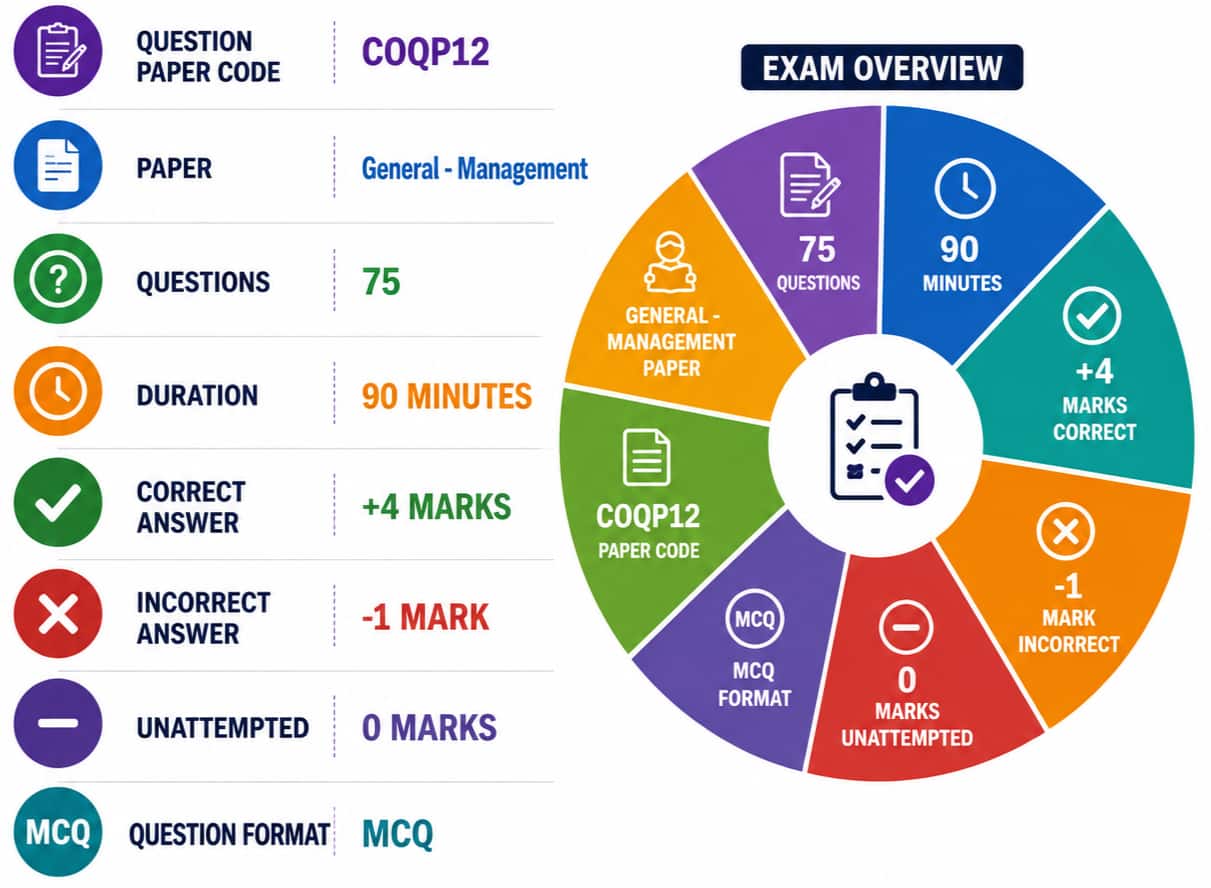
With 75 questions in 90 minutes, it makes speed and question selection important aspects of preparation.
CUET PG MBA Syllabus 2027: Based on the Latest Available Syllabus
As of the latest available information, the CUET PG MBA syllabus has not been released by NTA. Until the 2027 notification is issued, use the latest available COQP12 syllabus as the candidate’s preparation reference. It covers four broad areas: English/Comprehension, Maths/Quantitative Ability, Logical Reasoning and Data Interpretation. [Official: exams.nta.nic.in/cuet-pg/]
Section | Topics Covered |
English/Comprehension | English Grammar, English Usage Errors, Jumbled Para, Sentence Correction, Sentence Improvement, Reading Comprehension, Paragraph Completion, One-word Substitution, Synonyms and Antonyms, Idioms and Phrases; corresponding Hindi language and comprehension areas |
Maths/Quantitative Ability | Partnership, Simple Interest and Compound Interest, Profit and Loss, Percentages, Pipes and Cisterns, Time-Speed-Distance, Problems on Trains, Work and Wages, Time and Work |
Ranking Tests, Linear Arrangements, Matrix Arrangements, Sequencing, Critical Reasoning: Statements and Arguments, Cause and Effects, Statements and Assumptions, Statements and Conclusions, Number Series, Blood Relationship, Coding and Decoding, Inferences, Non-Verbal Reasoning, Analogy, Symbol-Based Problems, Direction and Distance | |
Pie Charts, Line Charts, Bar Graphs, Tabular Charts, Mixed Graphs, Data Sufficiency, Graph Number Systems, Tabulation, Sets and Venn Diagrams |
How to Prepare for CUET PG MBA from Scratch
If a candidate is starting CUET PG MBA preparation from scratch, first build a foundation before moving to full-length mocks. Begin with the topics in the latest available syllabus.
Follow this sequence:
Understand → Learn → Practise → Timed attempt→ Analyse → Reattempt
This gives enough time to develop both conceptual clarity and exam speed.
Step 1: Take a Diagnostic Test
Begin with one mixed test covering all four areas.
The initial score is not the important part. Identify whether they need stronger basics, more application practice, better speed, higher accuracy, or improved question selection.
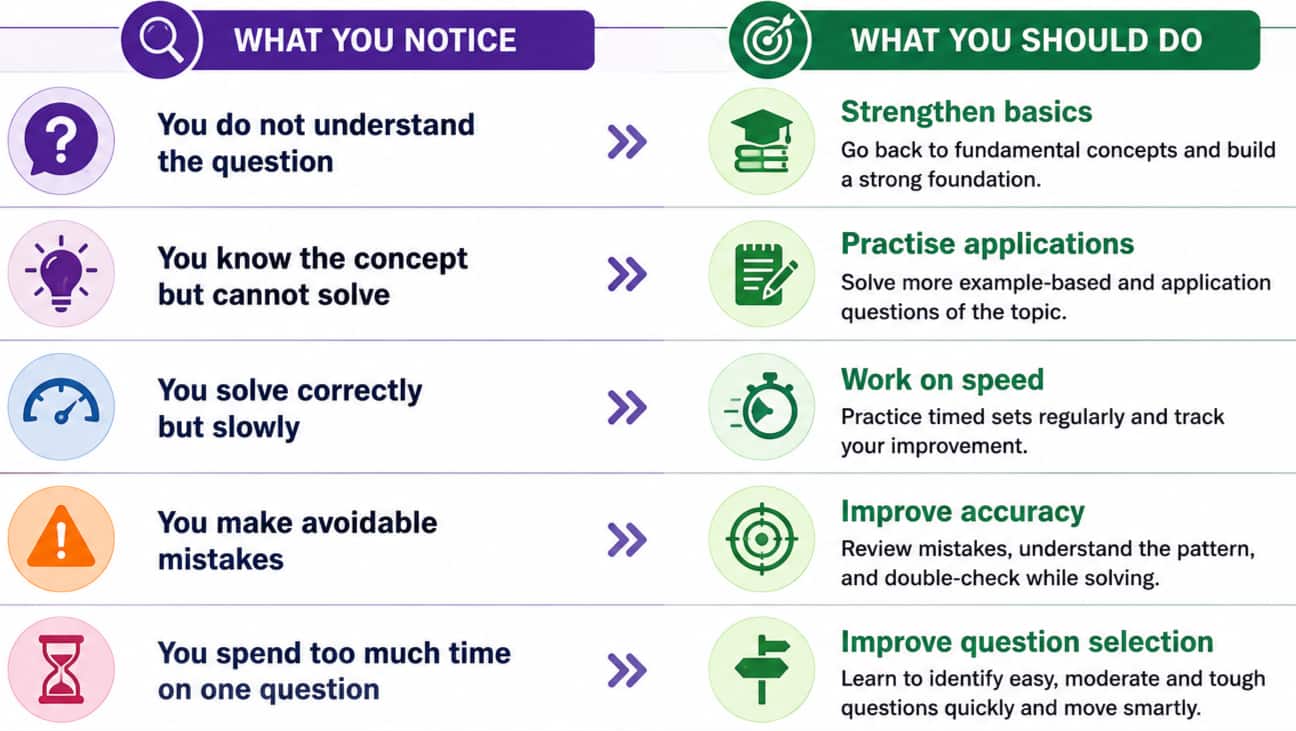
This gives a realistic starting point for the CUET PG MBA preparation strategy.
Step 2: Build Quantitative Ability Foundation
Start with arithmetic topics that support multiple concepts. Follow this order:
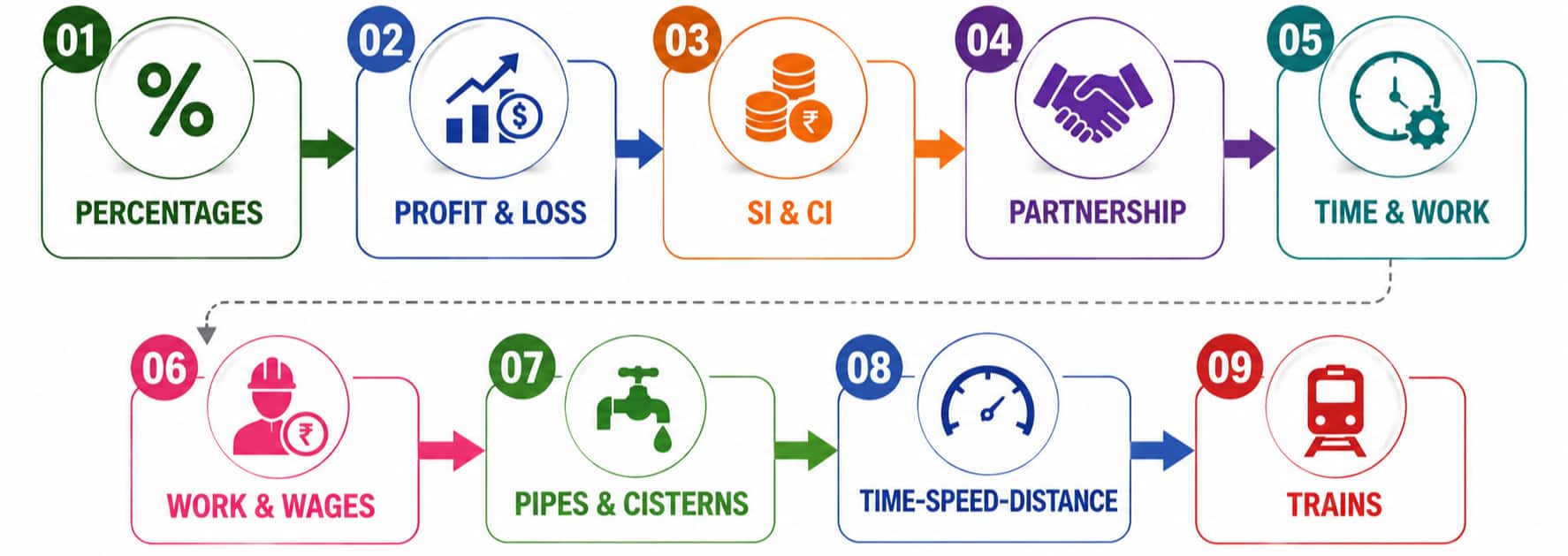
Do not memorise formulas without understanding where they are used.
Step 3: Build Logical Reasoning Skills
Start with ranking, directions, and blood relations. Move to coding-decoding, number series, analogy, sequencing and arrangements, then practise assumptions, arguments, conclusions and inferences before mixed sets.
Step 4: Improve English Every Day
Practise grammar, vocabulary and comprehension regularly. Focus on sentence correction, para jumbles, paragraph completion, synonyms, antonyms, one-word substitutions, idioms and Reading Comprehension.
Step 5: Add Data Interpretation Gradually
Start with tables and bar graphs, then practise line charts, pie charts and mixed graphs. Move to Data Sufficiency and Venn diagrams, focusing on calculation speed and accuracy.
Strengthen CUET PG MBA English preparation with focused study material covering key concepts and important topics for the English/Comprehension section.
Download now: CUET PG MBA English PDF
CUET PG MBA Preparation Strategy 2027
Candidates can divide their preparation into three phases.
Phase 1: Foundation
Complete the syllabus topic by topic and build basic concepts. At this stage, accuracy matters more than speed.
Phase 2: Practice
Move to mixed questions, sectional tests, and timed practice. Start tracking the time taken on different question types.
Phase 3: Exam Preparation
In the final stage, focus on full-length mocks, previous-year questions, revision, and error analysis.
The aim should be to convert conceptual knowledge into fast and accurate decision-making.
CUET PG MBA 12-Week Study Plan
Aspirants can use this three-month plan as a starting framework.
Weeks | Focus |
1-2 | Quantitative Ability (QA)basics, grammar, basic reasoning + topic-wise practice |
3-4 | Percentages, Profit & Loss, SI-CI, vocabulary, ranking, directions + timed sets |
5-6 | Partnership, Time & Work, Pipes, TSD, trains, coding, blood relations + mixed practice |
7-8 | Arrangements, sequencing, statements, assumptions, conclusions, RC + sectional practice |
9-10 | DI, mixed Quant, mixed reasoning + sectional tests |
11 | Previous-year questions + full-length mocks + error analysis |
12 | Revision, weak areas, formulas + timed practice |
Can also extend the foundation stage if the candidate is beginning with weak Quantitative Ability (QA)or Reasoning basics.
CUET PG MBA Daily Study Plan
A five-hour routine can give sufficient structured practice without making preparation unnecessarily complicated.
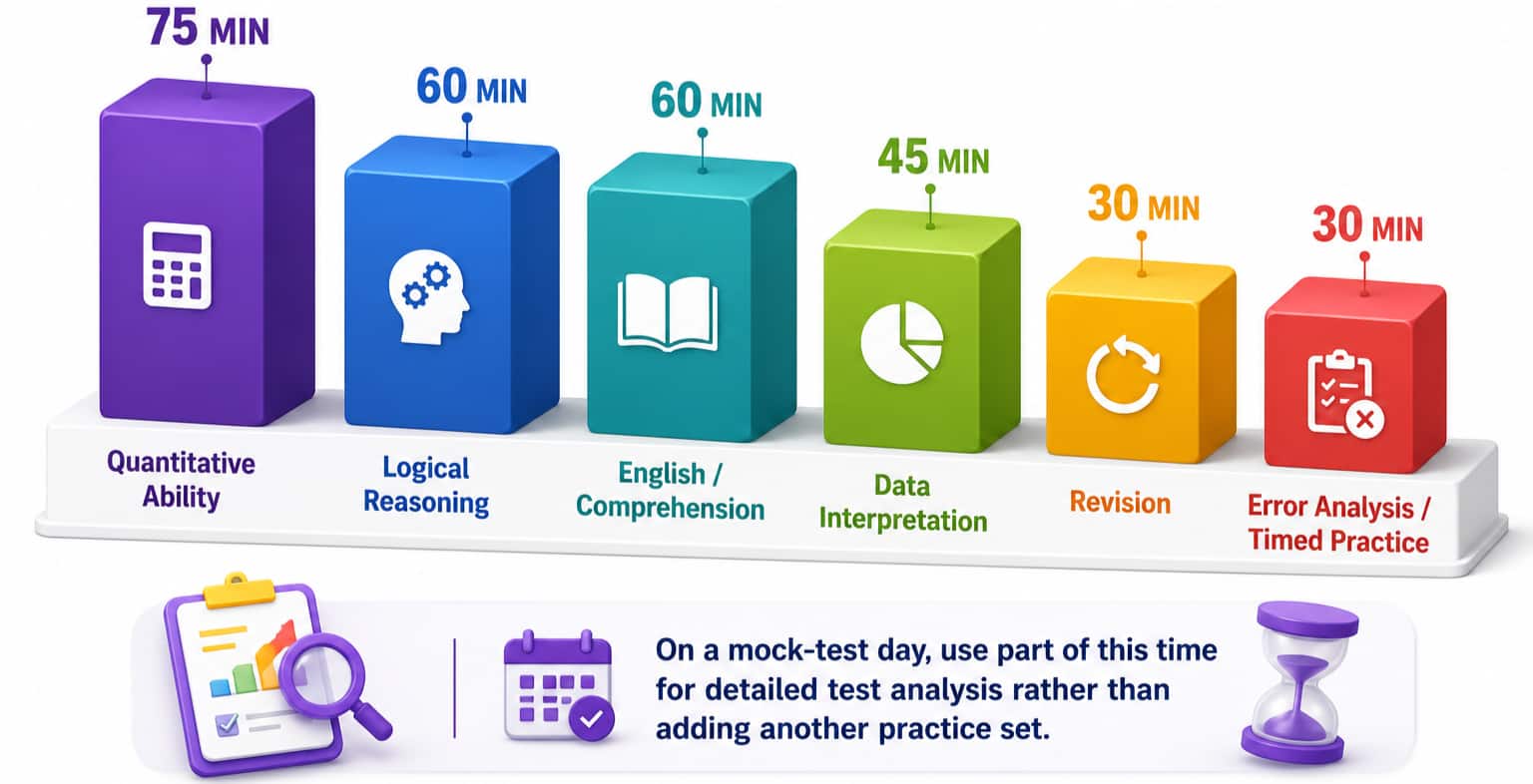
Study Area | What to Do |
Quantitative Ability | Learn one concept + solve topic-wise questions |
Logical Reasoning | Concept practice + timed questions |
English/Comprehension | Grammar, vocabulary, or RC |
Data Interpretation | Solve charts/tables and improve calculation speed |
Revision | Revise formulas, concepts, and vocabulary |
Error Analysis | Review incorrect and time-consuming questions |
How to Improve Speed for CUET PG MBA
With 90 minutes for 75 questions in the latest available pattern, build speed gradually. Start with timed questions, move to sectional tests, and then full-length mocks.
Track Attempted → Correct → Wrong → Skipped → Time Taken to identify where the candidate is losing time or marks.
CUET PG MBA PYQs and Mock Tests
Use CUET PG MBA PYQs after completing the basics to understand question types and improve exam familiarity.
Follow this progression:
Topic-wise practice → Mixed practice → Sectional tests → Full-length mocks.
After each test, review wrong answers, guesses, time-consuming questions, and skipped questions to improve approach.
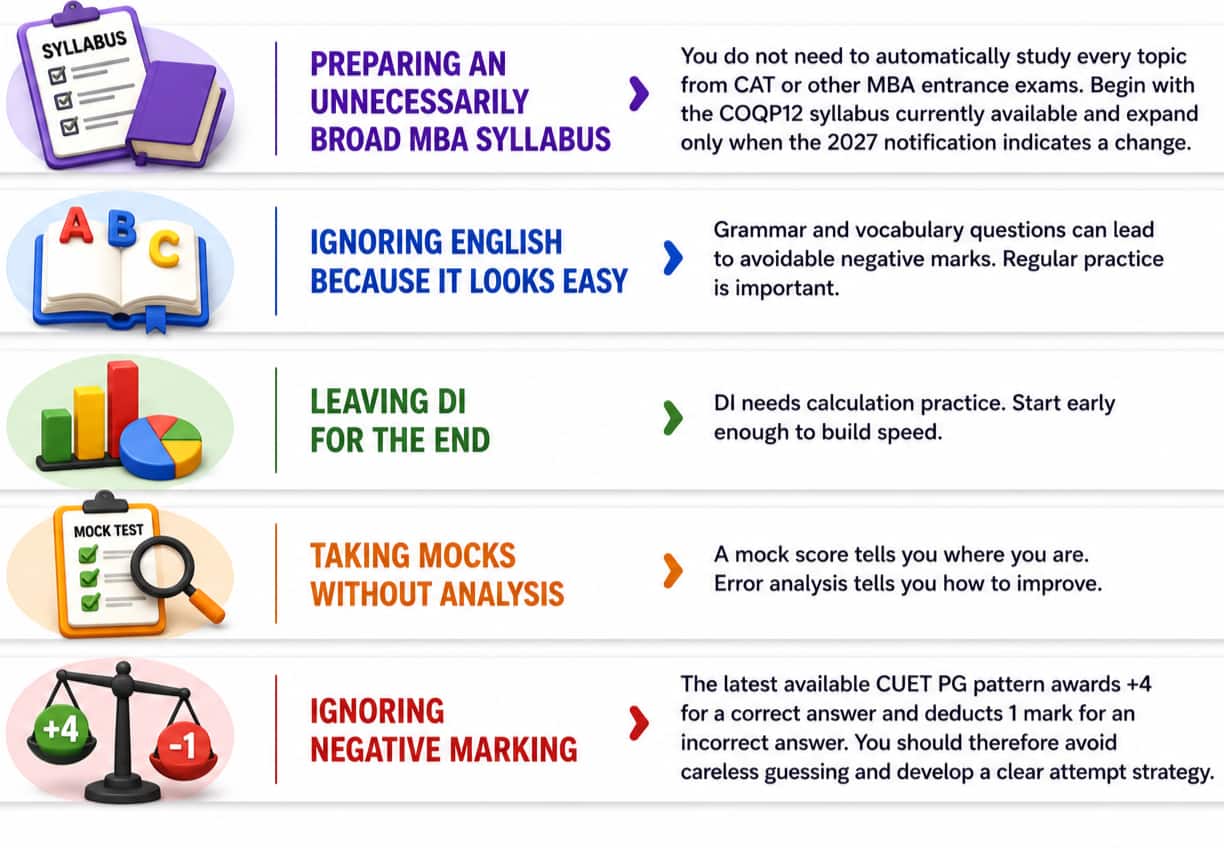
Common Mistakes to Avoid
This section highlights the common mistakes one should avoid during CUET PG MBA preparation:
CUET PG MBA Preparation 2027: What Should Candidates Prioritise?
Based on the latest available COQP12 syllabus, candidates can begin with these areas:
Priority | Topics |
Very High | Percentages, Profit & Loss, SI-CI, Time & Work, TSD, Grammar, RC |
High | Coding-Decoding, Directions, Blood Relations, Ranking, Number Series |
High | Arrangements, Sequencing, Statements, Assumptions, Conclusions |
Regular practice | Tables, Bar Graphs, Line Charts, Pie Charts, Mixed Graphs, Data Sufficiency |
Vocabulary practice | Synonyms, Antonyms, One-word Substitution, Idioms |
This is a preparation priority, not a prediction of the exact 2027 question distribution. NTA may change the syllabus or pattern when the 2027 cycle is formally announced.
Frequently Asked Questions (FAQs)
The latest available syllabus includes Partnership, SI-CI, Profit & Loss, Percentages, Pipes and Cisterns, Time-Speed-Distance, Problems on Trains, Work and Wages, and Time and Work.
Candidates should prepare ranking, arrangements, sequencing, statements and arguments, assumptions, conclusions, number series, blood relations, coding-decoding, inferences, analogy, symbol-based problems, and directions.
