


CUET PG MBA 2026 Exam Analysis (Available After Exam): Section-Wise Review, Difficulty Level & Good Attempts
The CUET PG MBA Exam Analysis 2026 helps candidates understand the overall difficulty level and structure of the examination. The National Testing Agency (NTA) conducted the CUET PG MBA 2026 exam on March 08, 2026, in a single shift from 12:30 PM to 2:00 PM. The examination is now over, and we have provided the detailed CUET PG MBA 2026 exam analysis here for candidates. Along with the analysis, we will also included memory-based questions from all four sections asked in the CUET PG MBA 2026 exam to help candidates review the paper.
This Story also Contains
- CUET PG MBA 2026 Overview
- CUET PG MBA 2026 Exam Analysis
- CUET PG MBA Memory-Based Questions
- Why is CUET PG MBA Analysis Important?
- Best Resources to Ace CUET PG MBA 2026 Exam

CUET PG MBA 2026 Overview
The candidates can get a quick overview of the CUET PG MBA Exam Pattern 2026 from the table below.
Particulars | CUET PG Exam Details |
Types of questions | MCQs |
Total number of questions | 75 |
Total marks in CUET PG | 300 marks |
Exam mode | Computer-based mode |
CUET PG passing marks | 45% marks |
CUET PG negative marking | Yes |
CUET PG Marking Scheme | 4 marks will be given for each correct response.1 mark will be deducted for each incorrect response. |
CUET PG exam time duration | 90 Minutes |
CUET PG Conducting Authority | National Testing Agency (NTA) |
Sections Covered | 1. Language Comprehension 2. Quantitative Ability 3. Logical Reasoning 4. Data Interpretation |
CUET PG MBA 2026 Exam Analysis
The CUET PG MBA paper was overall moderate to slightly difficult, with the difficulty level appearing higher compared to previous years. One of the major observations from this paper was that it was heavily inclined towards Quantitative Aptitude and Data Interpretation, which made the paper lengthy and time-consuming for many candidates.
A large portion of the questions came from quantitative and DI-based topics, increasing the calculation load during the exam. Although the reasoning and English sections were comparatively easier, the overall paper still required strong time management and numerical accuracy due to the lengthy nature of several questions.
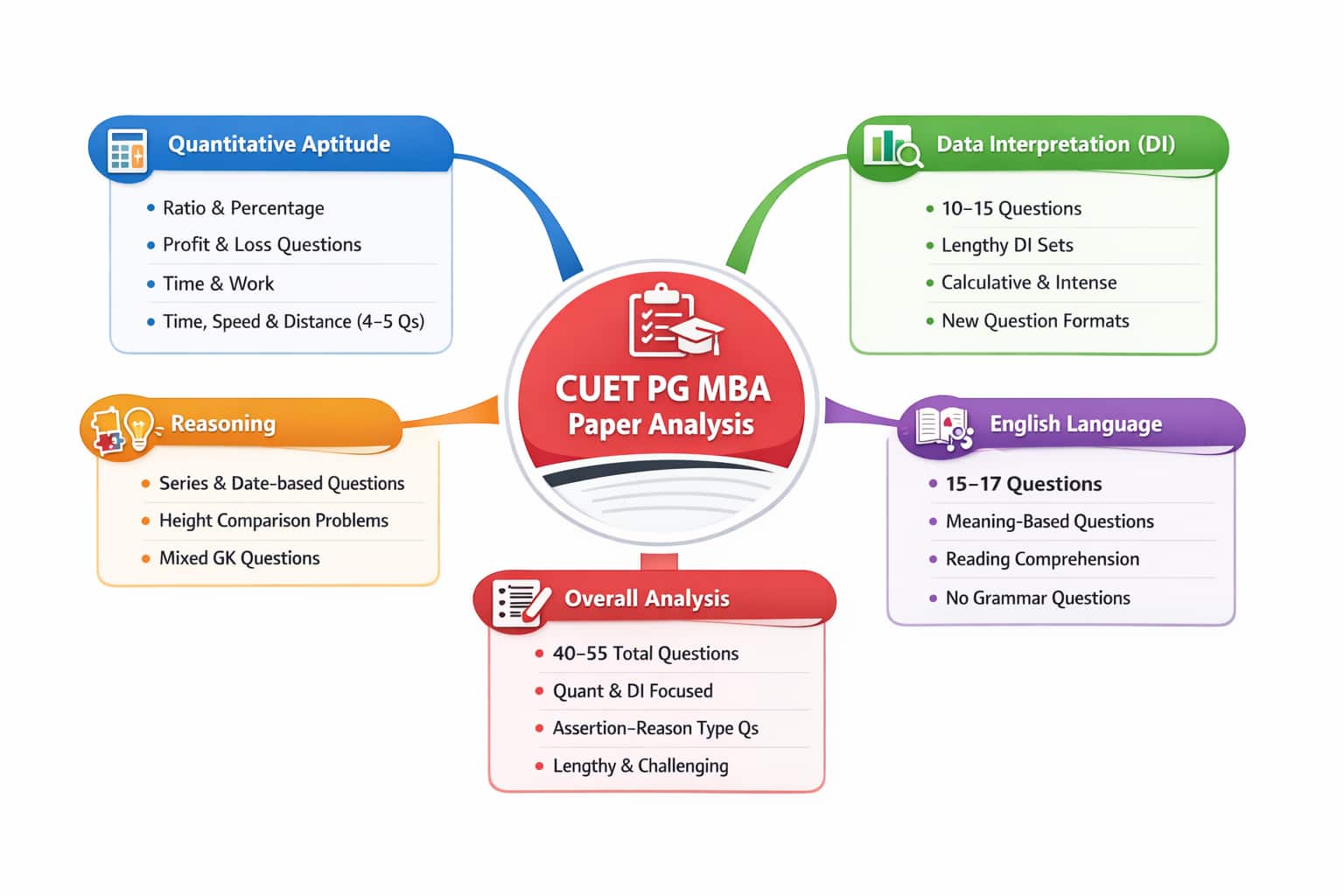
Key highlights of the paper include:
The paper contained approximately 40–55 questions overall.
A large number of questions were from Quantitative Aptitude and Data Interpretation.
Data Interpretation alone contributed around 10–15 questions, making it a major part of the paper.
Several questions appeared in an assertion–reason format, which required conceptual understanding.
The paper was more calculation-oriented compared to the previous year's papers.
Many candidates felt the paper was lengthy, especially due to DI sets and arithmetic problems.
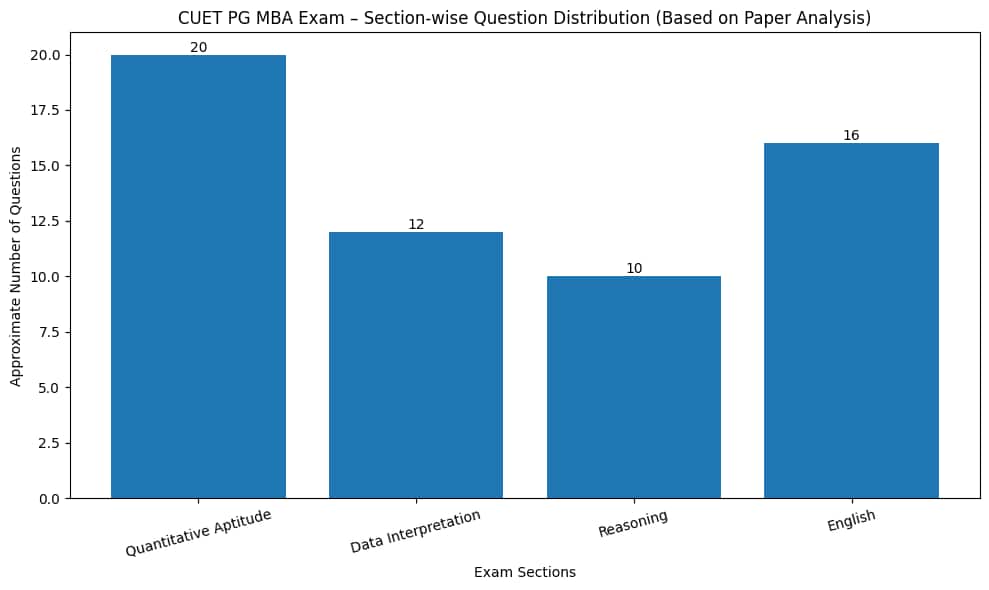
Below is the chart with section-wise question distribution as shared by the candidates. The exact number of questions may vary.
Quantitative Aptitude Analysis
The Quantitative Aptitude section had the highest weightage in the paper, making it the most important section for candidates attempting the exam. Although the conceptual level of questions was not extremely difficult, the number of questions and the calculation involved made the section time-consuming.
Important topics observed in this section included:
Ratio and Proportion
Percentages
Profit and Loss
Time and Work
Time, Speed and Distance (around 4–5 questions)
Observations from the Quant section:
Arithmetic topics dominated the section.
Profit and Loss questions appeared frequently, especially those related to loss calculations.
Most questions required step-by-step calculations, which increased the solving time.
Candidates with strong fundamentals in basic arithmetic and percentage-based concepts had an advantage.
Overall, this section played a major role in determining the difficulty of the paper because of its length and numerical calculations.
Data Interpretation (DI) Analysis
Data Interpretation was one of the most prominent and challenging parts of the CUET PG MBA paper. The section included around 10–15 questions, which were based on multiple DI sets.
Important observations from DI:
DI sets were lengthy and required careful reading before solving questions.
In several cases, only one question was asked from each set, meaning candidates had to analyze an entire set for a single question.
Questions were calculation-intensive, making them time-consuming.
Some new formats of DI questions were also observed, which added to the complexity.
The overall DI section required strong numerical interpretation and quick calculations.
Because of these factors, many candidates felt that DI contributed significantly to the overall length of the paper.
Logical Reasoning Analysis
The Reasoning section was comparatively easier than Quantitative Aptitude and Data Interpretation. Most questions were logic-based and could be solved quickly with proper interpretation.
Types of questions asked included:
Series-based questions
Date-based reasoning questions
Comparison-based questions, such as height differences
Set-based logical questions
Mixed conceptual questions involving topics like geography, science, and gravitation
Key observations:
The reasoning section was less calculation-heavy and more logic-oriented.
Most questions required simple logical deduction rather than complex analysis.
Candidates who carefully read the conditions could solve the questions relatively quickly.
Overall, this section was one of the easier parts of the paper, helping candidates balance their time between Quant and DI.
English Language Analysis
The English section was relatively easy and contained fewer questions compared to other sections. The focus of the section was primarily on understanding meanings and basic comprehension skills.
Important characteristics of the English section:
Approximately 15–17 questions appeared in this section.
The questions were mainly meaning-based rather than grammar-focused.
Vocabulary and contextual understanding played a key role.
The section also included reading-based questions, testing interpretation skills.
Because the questions were straightforward, candidates with good vocabulary and reading ability were able to attempt this section quickly.
CUET PG MBA 2026 Data Interpretation Exam Analysis
The detailed CUET PG MBA 2026 exam analysis will be available shortly here.
CUET PG MBA Memory-Based Questions
The CUET PG MBA question paper will include memory-based questions compiled by the Careers360 team soon after the exam concludes. Candidates are advised to regularly check this page for CUET PG MBA 2026 memory-based question papers and subject-wise questions. These papers will help aspirants understand the exam pattern, difficulty level, and important topics asked in the exam.
English/Verbal Ability Questions
It will be provided on 08 March, 2026.
Quantitative Ability Questions
It will be provided on 08 March, 2026.
Logical Reasoning Questions
It will be provided on 08 March, 2026.
Data Interpretation Questions
It will be provided on 08 March, 2026.
Why is CUET PG MBA Analysis Important?
The CUET PG MBA 2026 exam analysis is important for understanding the latest exam trends and overall difficulty level. It helps candidates know which topics have more weight and how questions are framed in each section.
By going through the analysis, students can understand the updated exam pattern, question trends, and section-wise difficulty.
CUET PG MBA 2026 also helps in identifying high-weightage topics, frequently asked concepts, and the types of questions that are likely to appear in CUET PG MBA 2026.
Analysing the exam review allows candidates to compare their preparation with the actual exam standard and judge whether the paper was easy, moderate, or difficult.
The CUET PG MBA analysis 2026 also makes them familiar with the wording, structure, and complexity of questions, reducing last-minute surprises on exam day.
Best Resources to Ace CUET PG MBA 2026 Exam
CUET PG MBA Preparation Resources by Careers360 are designed to help candidates prepare effectively for the exam with reliable and exam-focused content. These resources include important topics, previous year questions, preparation tips, and exam strategies based on actual CUET PG trends. Using these CUET PG MBA study materials helps aspirants understand the exam pattern better, strengthen core concepts, and plan their preparation in a structured way.
CUET PG Preparation Resources | Download Link |
CUET PG MBA Question Paper 2025 | |
Available Soon | |
CUET PG MBA 2026 Vocabulary List | |
CUET PG MBA 2026: Quantitative Aptitude Questions With Solutions | |
CUET PG MBA 2026: Data Interpretation Questions With Solutions |
Frequently Asked Questions (FAQs)
The CUET PG MBA question paper consists of 75 multiple-choice questions (MCQs) carrying a total of 300 marks. Each correct answer carries 4 marks, and 1 mark is deducted for every incorrect response.
The CUET PG MBA question paper generally includes topics such as Quantitative Aptitude, Logical Reasoning, Data Interpretation, and General Awareness, depending on the MBA programme requirements.
Yes, there is negative marking, and one mark is deducted for each wrong answer.
The total duration of the CUET PG MBA exam is 90 minutes.
Candidates can download previous year CUET PG MBA question papers from the official NTA website or trusted education portals to practice and understand the exam pattern.