MAH MBA CET Quantitative Aptitude Practice Questions
Solving many of the problems of the MAH MBA CET Quantitative Section will not just improve the fluency but also make the habit of quick and correct solving of the problems. This section of the test needs knowledge of the fundamental Arithmetic, Algebra, Geometry, and reading graphical data, and therefore, the candidate must have a well-executed plan to achieve a good score bracket. Here, you will find a few MAH MBA CET Quantitative Aptitude questions of practice to help you understand the format of the test, improve your mathematical skills, and raise the discussion to the test.
1- Suppose f (x, y) is a real-valued function such that f (3x + 2y,2x −5y) =19x, for all real numbers x and y. The value of x for which f (x, 2x) = 27, is:
1) 3
2) 2
3) 4
4) 5
Solution:
Let m = 3x + 2y; and n = 2x - 5y
Multiply 1st equation by 5 and the second by 2 and then add both.
We get, 5m + 2n = 19x
So, we write: f (m, n) = 5m + 2n
Put m = x and n = 2x
So, f (x, 2x) = 5x + 4x = 9x = 27
So, x = 3
Hence, the correct answer is option (1).
2- The value of $1+\left(1+\frac{1}{3}\right) \frac{1}{4}+\left(1+\frac{1}{3}+\frac{1}{9}\right) \frac{1}{16}+\left(1+\frac{1}{3}+\frac{1}{9}+\frac{1}{27}\right) \frac{1}{64}+\cdots$ is:
1) $\frac{15}{13}$
2) $\frac{27}{12}$
3) $\frac{16}{11}$
4) $\frac{15}{8}$
Solution:
First, find the general term of the series (Series in the bracket is the sum of n terms with first term 1 and common ratio $\frac13$, and the terms in the multiplication form a GP with common ratio $\frac14$)
Since the general term is the sum of $n$ terms,
$A=\frac{a(1- r^n)}{1-r}$
where $a=1$
$r=\frac{1}{3}$
$T_n=A\times R^{n-1}$
$R=\frac{1}{4}$
$T_n=\left( \frac{1- \frac {1}{3^n}}{1-\frac{1}{3}}\right)\times (\frac{1}{4})^{n-1}$
$=\left( \frac{(3^n- 1) \times 3}{2 \times 3^n}\right)\times (\frac{1}{4})^{n-1}$
$= \frac32[1 - \frac{1}{3^n}] \times (\frac{1}{4})^{n-1}$
$= [\frac32 - \frac{1}{2 \times 3^{n-1}}] \times (\frac{1}{4})^{n-1}$
$= [\frac3{2 \times 4^{n-1}} - \frac{1}{2 \times 12^{n-1}}] $
This is an infinite GP.
So, Sum = $\frac{\frac32}{1- \frac14}-\frac{\frac12}{1-\frac12} =2 - \frac6{11} = \frac{16}{11}$
Hence, the correct answer is option (3).
3- Let an = 46 + 8n and bn = 98 + 4n be two sequences for natural numbers n ≤ 100. Then, the sum of all terms common to both the sequences is:
1) 14900
2) 15000
3) 14798
4) 14602
Solution:
For better understanding, take $n = m$ in the second series.
Find the terms where $a_{n}=b_{m}$
So, $46 + 8n = 98 + 4m$
⇒ $8n – 4m = 52$
⇒ $2n – m = 13$
If $m = 1, n = 7$
So, the first common term = 98 + 4 = 102
Common difference for this series of common terms = LCM of 8 and 4 = 8
So, the series is like $102, 110, 118,$ ……….
Now, find the largest such value of $m$,
$2n – m = 13$
⇒ $m = 2n – 13$
If $n = 56$, we get, $m = 99$.
Last term of common series $= 98 + 4(99) = 494$
Number of common terms = $\frac{(494 – 102)}{8}+ 1 = 50$
$\therefore$ Required sum = $\frac{50(102 + 494)}{2} = 14900$
Hence, the correct answer is option (1).
4- In a regular polygon, any interior angle exceeds the exterior angle by 120 degrees. Then, the number of diagonals of this polygon is:
1) 54
2) 34
3) 44
4) 24
Solution:
Interior angle of a $n$ sided regular polygon $=\frac{180(n-2)}{n}$
Exterior angle of a $n$ sided regular polygon $=\frac{360}{n}$
According to the question:
$
\frac{180(n-2)}{n}-\frac{360}{n}=120
$
$
\begin{aligned}
& \Rightarrow \frac{180 n-360-360}{n}=120 \\
& \Rightarrow 180 n-720=120 n \\
& \Rightarrow n=12
\end{aligned}
$
$\therefore$ Number of diagonals $=\frac {n(n-3)}{2}=\frac{12(12-3)}{2}=54$
Hence, the correct answer is option (1).
5- A rectangle with the largest possible area is drawn inside a semicircle of radius 2 cm. Then, the ratio of the lengths of the largest to the smallest side of this rectangle is:
1) $1:1$
2) $\sqrt{5}: 1$
3) $\sqrt{2}: 1$
4) $2:1$
Solution:
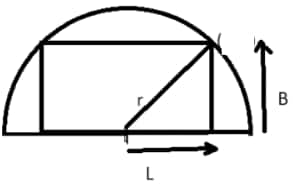
A rectangle is symmetric about the center.
If the length is $2L$ and the breadth is $B$.
![1741769560607]() Using Pythagoras theorem, we get,$L^2+B^2 = 2^2$
Using Pythagoras theorem, we get,$L^2+B^2 = 2^2$
So, $B^2 = 2^2-L^2$
⇒ $B = \sqrt {2^2-L^2}$
Area = $2L × B$
= $2L × \sqrt {4-L^2}$
Squaring both sides,
Area2 = $4L^2 × (4-L^2)$
= $4(4L^2-L^4)$
= $4(4L^2-L^4 + 4 -4)$
= $4(4-(2 - L^2)^2)$
So, for the area to be maximum,
$2 = L^2$
$⇒L=\sqrt2$
So, $B = \sqrt {2^2-(\sqrt2)^2}= \sqrt2$
$\therefore$ Required ratio = $\frac{2L}{B} = 2\sqrt2: \sqrt2 = 2: 1$
Hence, the correct answer is option (4).
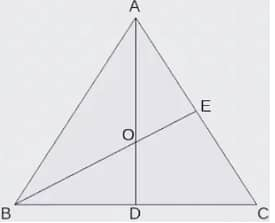
6- Let ABC be an isosceles triangle such that AB and AC are of equal length. AD is the altitude from A on BC and BE is the altitude from B on AC. If AD and BE intersect at O such that $\angle AOB = 105º$, then $\frac{AD}{BE}$ =?
1) sin15°
2) cos15°
3) 2cos15°
4) 2sin15°
Solution:
![1741769560941]() $\angle \mathrm{AOB}=105^{\circ}$So, $\angle \mathrm{DOE}=105^{\circ}$ (vertically opposite angles are equal)
$\angle \mathrm{AOB}=105^{\circ}$So, $\angle \mathrm{DOE}=105^{\circ}$ (vertically opposite angles are equal)
$\angle \mathrm{C}=75^{\circ}$ (Sum of all angles of a quadrilateral OECD is $360^{\circ}$ and the other two angles are $90^{\circ}$ each)
$\angle B=75^{\circ}$ (Angles opposite to equal sides are equal; $A B=A C$ )
So, $\angle \mathrm{OBD}=15^{\circ}$ (Using sum of all angles in a triangle is $180^{\circ}$ )
$\angle \mathrm{A}=30^{\circ}$ (Using sum of all angles in a triangle is $180^{\circ}$ )
Now, Area of triangle $A B C=\frac12(A D)(B C)=\frac12(A C)(B E)$
So, $\frac{A D}{B E}=\frac{A C}{B C}$
In triangle $A B E, \sin 30^{\circ}=\frac{B E}{A B}=\frac{B E}{A C}$ (Since $A B=A C$ )
$\Rightarrow \frac12=\frac{B E}{A C}$
$\Rightarrow \mathrm{AC}=2 \mathrm{BE}$
In triangle $B E C, \operatorname{cos} 15^{\circ}=\frac{B E}{B C}$
From equations 1, 2, and 3,
$
\frac{A D}{B E}=\frac{2 B E}{\frac{B E }{\cos 15^{\circ}}}=2 \cos 15^{\circ}
$
Hence, the correct answer is option (3).
7- A fruit seller has a stock of mangoes, bananas, and apples with at least one fruit of each type. At the beginning of the day, the number of mangoes makes up 40% of his stock. That day, he sells half of the mangoes, 96 bananas, and 40% of the apples. At the end of the day, he ends up selling 50% of the fruits. The smallest possible total number of fruits in the stock at the beginning of the day is:
1) 340
2) 280
3) 320
4) 360
Solution:
Let the total fruits at the beginning be 100x.
Mangoes = 40x
Banana + apple = 60x
If Banana = y, then Apple = 60x – y
Total fruits sold = 50% = 50x
According to the question,
50x = 20x + 96 + 40% of (60x -y)
⇒ 30x = 96 + 24x – 40% of y
⇒ 6x = 96 – 40% of y = 96 – 0.4y
⇒ x = 16 – $\frac{2y}{30}$ = 16 – $\frac{y}{15}$
⇒ 100x = 1600 – $\frac{100y}{15}$
⇒ 100x = 1600 – $\frac{20y}{3}$
To get a minimum value of 100x, y should be maximum and a multiple of 3 so that 100x remains positive and integer. Also, y ≥ 96.
Also 60x – y should be a non-zero integer.
i.e. 60 (16 – $\frac{y}{15}$) – y is non-zero.
If we put this value equal to zero, we get,
⇒ 960 – 5y = 0
⇒ y = 192
So, y should be less than 192.
So, the maximum multiple of 3 between 96 and 192 is 189.
So, y = 189
Hence, total fruits = 100x = 1600 – 20($\frac{189}{3}$) = 1600 – 1260 = 340
Hence, the correct answer is option (1).
8- The number of coins collected per week by two coin collectors A and B are in the ratio 3:4. If the total number of coins collected by A in 5 weeks is a multiple of 7, and the total number of coins collected by B in 3 weeks is a multiple of 24, then the minimum possible number of coins collected by A in one week is:
1) 42
2) 52
3) 62
4) 72
Solution:
Let the total coins collected by A in 5 weeks = 7x
Let the total coins collected by B in 3 weeks = 24y
According to the question,
$\frac{7x}{5}:\frac{24y}{3} = 3: 4$
So, $x : y = 30 : 7$
For the minimum number of coins collected by A, take x = 30
So, coins collected by A in a week = $\frac75$ of 30 = 42
Hence, the correct answer is option (1).
9- There are three people, A B, and C in a room. If a person D joins the room, the average weight of the persons in the room reduces by x kg. Instead of D, if person E joins the room, the average weight of the persons in the room increases by 2x kg. If the weight of E is 12 kg more than that of D, then the value of x is:
1) 1.5
2) 0.5
3) 1
4) 2
Solution:
According to the question,
$\frac{A+B+C}{3} - \frac{A+B+C+D}{4} = x$
And $\frac{A+B+C+E}{4} - \frac{A+B+C}{3} = 2x$
Adding both equations, we get,
$\frac{E-D}{4} = 3x$
⇒ $E-D = 12x$
Also, $E-D=12$
So, x = 1
Hence, the correct answer is option (3).
10- If is a positive real number such that $x^8 + (\frac {1}{x})^8 = 47$ , then the value of $x^9 + (\frac {1}{x})^9$ is:
1) $34 \sqrt{5}$
2) $40 \sqrt{5}$
3) $36 \sqrt{5}$
4) $30 \sqrt{5}$
Solution:
$x^8 + (\frac {1}{x})^8 = 47$
⇒ $(x^4 + \frac {1}{x^4})^2 - 2 = 47$
⇒ $(x^4 + \frac {1}{x^4})^2 = 49$
⇒ $x^4 + \frac {1}{x^4} = 7$
⇒ $(x^2 + \frac {1}{x^2})^2 - 2 = 7$
⇒ $(x^2 + \frac {1}{x^2})^2 = 9$
⇒ $x^2 + \frac {1}{x^2} = 3$
⇒ $(x + \frac {1}{x})^2 -2 = 3$
⇒ $x + \frac {1}{x} = \sqrt 5$
Cubing both sides, we get,
⇒ $(x + \frac {1}{x})^3 = 5 \sqrt 5$
⇒ $x^3 + \frac {1}{x^3} +3 \times \sqrt 5 = 5 \sqrt 5$
⇒ $x^3 + \frac {1}{x^3} = 2 \sqrt 5$
Cubing both sides, we get,
⇒ $x^9 + \frac {1}{x^9} + 3 \times 2 \sqrt 5 = 40 \sqrt 5$
$\therefore x^9 + \frac {1}{x^9} = 34 \sqrt 5$
Hence, the correct answer is option (1).
11- Let an and bn be two sequences such that an= 13 + 6(n−1) and bn = 15 + 7(n−1) for all natural numbers n. Then, the largest three-digit integer that is common to both these sequences, is:
1) 967
2) 850
3) 758
4) 980
Solution:
Here, $a_n=13+6(n-1)=7+6n$ and $b_{n}=8+7n$
The common difference of terms that exists in both series is LCM of $(6, 7) = 42$
Now, by writing the series up to a few terms, the first common term of the first two series = 43
Now, $t_m=a+(m-1)d<1000$
⇒ $43 + (m - 1)42 < 1000$
On solving, we get $m < 23.8$
So, take $m = 23$
Now, the largest three-digit common term $= 43 + (22 × 42) = 967$
Hence, the correct answer is option (1).
12- The salaries of three friends Sita, Gita, and Mita are initially in the ratio 5:6:7, respectively. In the first year, they get salary hikes of 20%, 25%, and 20%, respectively. In the second year, Sita and Mita get salary hikes of 40% and 25%, respectively, and the salary of Gita becomes equal to the mean salary of the three friends. The salary hike of Gita in the second year is:
1) 26%
2) 28%
3) 25%
4) 30%
Solution:
Let the initial salaries of Sita, Gita and Mita be 500, 600 and 700 respectively.
After getting 20%, 25% and 20% salary hikes respectively, their salaries become 600, 750 and 840 respectively.
In the second year, Sita and Mita get 40% and 25% hikes respectively.
So, after two years the salaries of Sita and Mita are 840 and 1050 respectively.
We also know that Gita’s salary is the average of the salaries of the three which is equal to the average of the other two i.e. $\frac{840+1050}{2} = 945$
So, the hike in the salary of Gita during the second year = $\frac{945-750}{750} \times 100 = 26$%
Hence, the correct answer is option (1).
13- Let $n$ be the least positive integer such that $168$ is a factor of $1134^n$. If $m$ is the least positive integer such that $1134^n$ is a factor of $168^m$, then $(m+n)$ equals:
1) 12
2) 9
3) 15
4) 24
Solution:
The prime factorizations of 168 and 1134 are as follows:
$\begin{aligned}
& 168=2^3 \times 3 \times 7 \\
& 1134=2 \times 3^4 \times 7
\end{aligned}$
As we can see the power of $2$ in the factor of $168$ is $3$.
So, the smallest positive integral value of $n$, such that 168 is a factor of $1134^{\text {n }}$ is 3.
Now, $1134^n=1134^3=2^3 \times 3^{12} \times 7^3$
Since the power of 3 in the factor of $1134^3$ is $12$, and the smallest positive integral value of $m$, such that $1134^3$ is a factor of $168^{\mathrm{m}}$ is $12$.
Therefore, $m+n=12+3=15$
Hence, the correct answer is option (3).
14- Let α and β be the two distinct roots of the equation $2x^2−6x+k=0$, such that (α + β) and αβ are the distinct roots of the equation $x^2+px+p=0$. Then, the value of $8(k−p)$ is:
1) 6
2) 4
3) 3
4) 2
Solution:
For, $2x^2−6x+k=0$
$α+β = \frac{6}{2}=3$
and, $αβ = \frac{k}{2}$
For, $x^2+px+p=0$
$α+β +αβ = \frac{-p}{1}=-p$
and,$(α+β)αβ = \frac{p}{1}=p$
Adding these two equations,
$α+β +αβ +(α+β)αβ = 0$
Put the values of ($α+β$) and $αβ$, we get
$3 +\frac{k}{2}+ \frac{3k}{2}= 0$
So, $k = \frac{-3}{2}$
Also, we get using the above equations, $p= \frac{3k}{2} = \frac{-9}{4}$
So, $8(k−p)= 8[\frac{-3}{2}-(\frac{-9}{4})]=6$
Hence, the correct answer is option (1).
15- The sum of all possible values of $x$ satisfying the equation $2^{4x^2}−2^{2x^2+x+16}+2^{2x+30} = 0$, is:
1) $\frac{3}{2}$
2) $\frac{5}{2}$
3) $\frac{1}{2}$
4) $3$
Solution:
Given: $2^{4x^2}−2^{2x^2+x+16}+2^{2x+30} = 0$,
⇒ $(2^{2x^2})^2−2^{2x^2} \times 2^{x+15} \times 2 + (2^{x+15})^2 = 0$
⇒ $(2^{2x^2} - 2^{x+15})^2 = 0$
⇒ $2^{2x^2} = 2^{x+15}$
⇒ $2x^2 = x+15$
⇒ $2x^2- x-15=0$
⇒ $(2x+5)(x-3)=0$
⇒ $x = - \frac 52, 3$
So, the sum of all values of $x$ = $\frac 12$
Hence, the correct answer is option (3).



 Using Pythagoras theorem, we get,$L^2+B^2 = 2^2$
 $\angle \mathrm{AOB}=105^{\circ}$So, $\angle \mathrm{DOE}=105^{\circ}$ (vertically opposite angles are equal)
