Great Lakes - PGDM & PGPM Admissions 2027
Globally Recognized by AACSB (US) & AMBA (UK) | 18 LPA Avg. CTC for PGPM 2026


The Data Interpretation and Logical Reasoning (DILR) section plays a major role in the CAT 2026 exam, carrying around 22 questions spread across four to five sets. In recent CAT papers, the section has included a mix of DI and LR questions within the same set, making set selection as important as problem-solving skills. Candidates should practise a wide variety of puzzles, arrangements, caselets, tables, graphs, and Venn diagrams instead of focusing on one topic. Regular practice with previous years' CAT question papers and sectional mock tests helps improve accuracy, speed, and the ability to identify the most scoring sets during the exam.
This Story also Contains
In this article, we have discussed important MCQs, types of questions asked in the CAT 2026 DILR section, best books and preparation strategies to ace the section with high marks.
Data Interpretation and Logical Reasoning (DILR) is one of the most important sections in the CAT exam, contributing nearly one-third of the total marks. This section is often considered the toughest by many aspirants due to its variety of question types, including puzzles, graphs, charts, and complex data sets. To excel in CAT DILR, it is essential to have a clear understanding of the detailed CAT DILR syllabus and practice rigorously using the previous year’s CAT DILR questions (PYQs). Consistent practice helps improve problem-solving speed and accuracy. Developing strong analytical skills and mastering time management during the exam are crucial.
Practising the most important MCQs for CAT DILR 2026 helps improve speed, accuracy, and logical thinking. Focus on puzzles, seating arrangements, data tables, and caselets to build confidence. Solving well-picked questions daily strengthens your ability to handle complex sets efficiently.
The DILR section in the CAT exam measures how well you can interpret data and apply logical reasoning to solve problems efficiently. This part is critical because it requires quick thinking and accuracy under pressure. Candidates should deeply study the syllabus and engage in regular practice with a wide range of problems to master CAT DILR.
Parameter | Details |
Basic Concepts | Understanding basic concepts of DI and LR |
Sectional Time Limit | 40 minutes |
Number of Questions | 24 questions |
Time per Question | Approx. 1 minute 40 seconds |
To prepare well for the CAT, it’s crucial to fully grasp the complete exam syllabus. Pay special attention to the DILR section syllabus allows candidates to concentrate on important areas.
CAT Data Interpretation Logical Reasoning Syllabus |
Graphs Related |
Seating Arrangement, and Data Arrangement |
Data Sufficiency |
Tables and Caselets |
Assumption and Binary Logic |
Syllogism and Venn Diagram |
In this section, we will explore the different types of questions asked in the CAT DILR section. Understanding these question formats is essential as it helps candidates develop effective strategies to solve them efficiently.
1. Study the scatter graph given below which contains the sales of a firm during the first 6 months of 2023 and answer the questions that follow. Sales are measured in dollars
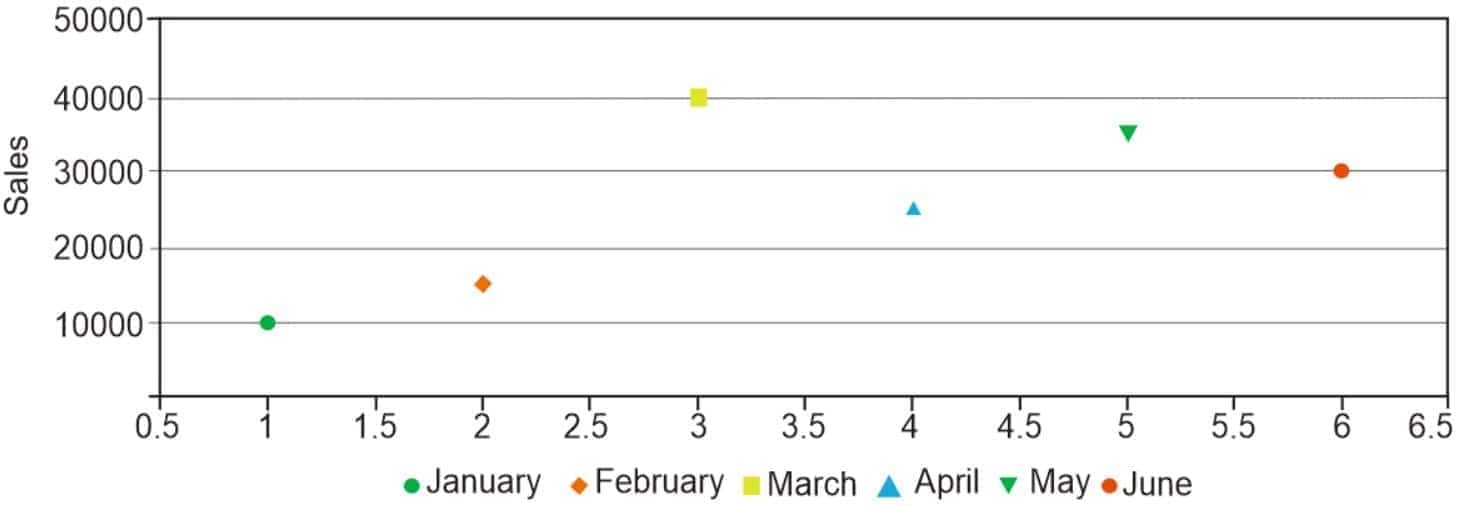
In which month was the greatest improvement in sales seen?
January
March
April
May
Solution:
The difference in sales is given by:
February to January: 15,000 - 10,000 = 5,000
March to February: 40,000 - 15,000 = 25,000
April to March: 25,000 - 40,000 = -15,000 (This is a drop in sales)
May to April: 35,000 - 25,000 = 10,000
June to May: 30,000 - 35,000 = -5,000 (This is a drop in sales)
The greatest improvement in sales is observed in March, where sales increased by 25,000 compared to the previous month, February. So, the greatest improvement was seen in March.
2. In which month was the greatest dip seen?
February
May
April
June
Solution:
The difference in sales is given by:
February to January: 15,000 - 10,000 = 5,000
March to February: 40,000 - 15,000 = 25,000
April to March: 25,000 - 40,000 = -15,000 (This is a drop in sales)
May to April: 35,000 - 25,000 = 10,000
June to May: 30,000 - 35,000 = -5,000 (This is a drop in sales)
Therefore, the greatest dip is observed in April, where sales decreased by 15,000 compared to the previous month, March. So, the greatest dip was seen in April.
3. What is the ratio of total sales in the first three months to total sales in the last three months?
13:18
18:13
1:3
3:1
Test centres are available in 70+ cities across India | 75,000+ aspirants apply for the NMAT exam | Accepted by 58+ institutions like NMIMS, KJSIM, ISB, SPJIMR and Great Lakes.
AACSB Accredited | 40 LPA-Highest CTC | Scholarships worth 10 CR
Solution:
Total Sales in the First Three Months:
January: $10,000
February: $15,000
March: $40,000
Total Sales in the First Three Months = 10,000 + 15,000 + 40,000 = 65,000
Total Sales in the Last Three Months:
April: $25,000
May: $35,000
June: $30,000
Total Sales in the Last Three Months = 25,000 + 35,000 + 30,000 = 90,000
Ratio = Total Sales in the First Three Months / Total Sales in the Last Three Months
Ratio = 65,000 / 90,000
So, the ratio of total sales in the first three months to total sales in the last three months is 13:18.
4. Find the average sales in dollars
$15,000
$25,000
$20,000
$25,833.33
Solution:
Given,
January: 10,000
February: 15,000
March: 40,000
April: 25,000
May: 35,000
June: $30,000
Total Sales = 10,000 + 15,000 + 40,000 + 25,000 + 35,000 + 30,000 = 155,000
Number of Months = 6
Now, calculate the average sales:
Average Sales = Total Sales / Number of Months
Average Sales = 155,000 / 6
Average Sales = 25,833.33 (rounded to two decimal places)
So, the average sales in dollars is approximately 25,833.33.
5. Find the difference between the month that had the highest sales and the month that had the least.
$25,000
$40,000
$5,000
$30,000
Solution:
Given the sales in dollars:
March had the highest sales with $40,000.
January had the least sales with $10,000.
To find the difference:
Difference = Sales in March - Sales in January
Difference = 40,000 - 10,000
Difference = $30,000
So, the difference between the month with the highest sales (March) and the month with the least sales (January) is $30,000.
1. Direction: Eight individuals, Emily, Francis, George, Henry, Isabella, Jacob, Kevin, and Liam, are seated around a square table with two on each side.
Among them, three are ladies, and they are not seated next to each other.
Jacob is situated between Liam and Francis.
George is seated between Isabella and Francis.
Henry, a lady member, is seated second to the left of Jacob.
Francis, a male member, is seated opposite Emily, a lady member.
There is a lady member seated between Francis and Isabella.
Question:
Who are the immediate neighbours of Isabella?
Emily and George
George and Francis
Henry and Liam
Jacob and Isabella
Solution:
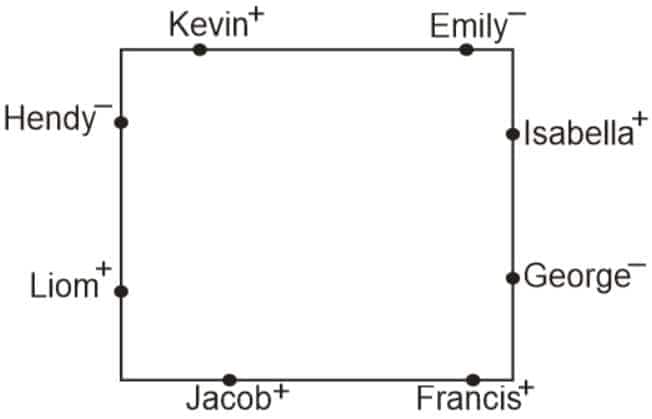
It can be seen from the above diagram that Isabella is sitting between George and Emily and hence they are the neighbours of Isabella.
2. Who sits in between George and Jacob?
Emily
Francis
Henry
Liam
Solution:
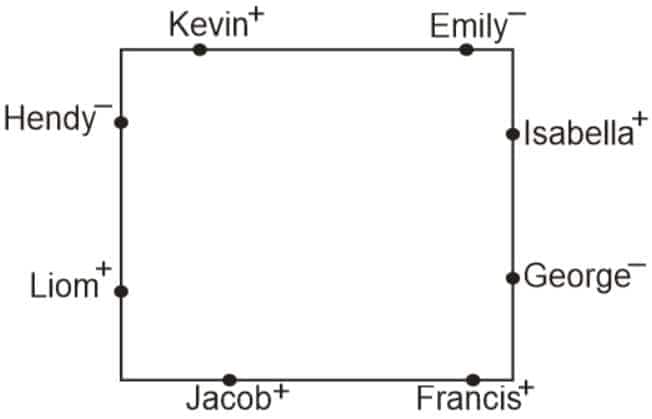
We can see from the above representation that Francis sits in between Jacob and Henry
3. How many people sit between Kevin and Francis?
3
1
2
0
Solution:
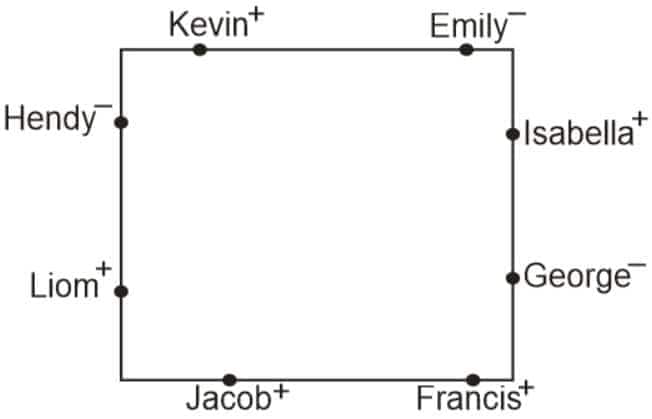
From the above square seating representation, it can be seen that three people (Emily, Isabella and George) sit between Kevin and Francis.
4. Who sits second to the left of George?
Emily
Henry
Jacob
Katherine
Solution:
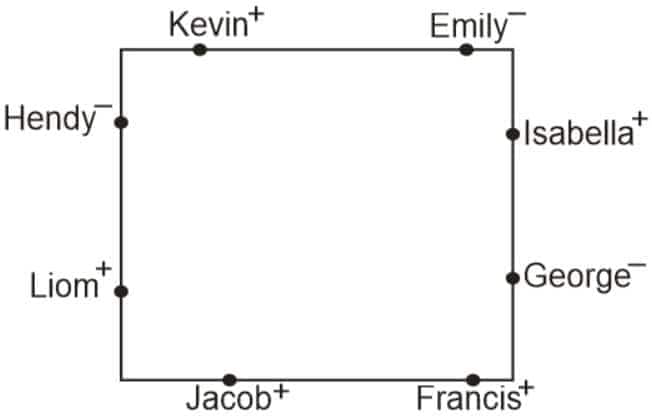
The second to the left of George can be found by moving clockwise from George to two positions. It will end in Jacob and hence, he sits second to the left of George
5. What is the position of Henry?
To the left of George and Isabella
To the right of Jacob and Felicia
Between Kevin and Liam
Opposite to Emily
Solution:
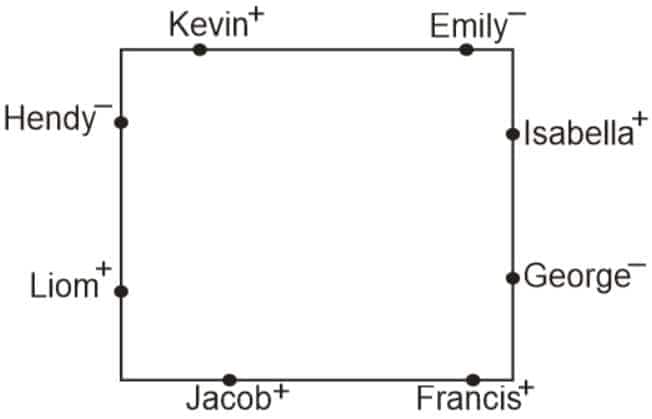
Given above is the representation of the seating of all 8 members. It can be seen that Henry is seated between Kevin and Liam.
Choosing the right books is essential to prepare effectively for the Data Interpretation and Logical Reasoning section of CAT. These CAT books 2026 cover a wide range of question types, strategies, and practice sets to build accuracy and speed. Candidates must use the books along with CAT Question Papers to prepare accordingly. Go through the table to know about the CAT DILR book name:
DILR Book Name | Author/Publisher |
How to Prepare for DILR for CAT | Arun Sharma |
Logical Reasoning and Data Interpretation for the CAT | Nishit K. Sinha |
Data Interpretation & Logical Reasoning for CAT | Pearson |
A Modern Approach to Logical Reasoning | R.S. Aggarwal |
The candidates can refer to a few CAT DILR questions from last year's examination.
The air-conditioner (AC) in a large room can be operated either in REGULAR mode or in POWER mode to reduce the temperature.
If the AC operates in REGULAR mode, then it brings down the temperature inside the room (called inside temperature) at a constant rate to the set temperature in 1 hour. If it operates in POWER mode, then this is achieved in 30 minutes.
If the AC is switched off, then the inside temperature rises at a constant rate so as to reach the temperature outside at the time of switching off in 1 hour.
The temperature outside has been falling at a constant rate from 7 pm onward until 3 am on a particular night. The following graph shows the inside temperature between 11 pm (23:00) and 2 am (2:00) that night.

The following facts are known about the AC operation that night:
The AC was turned on for the first time that night at 11 pm (23:00).
The AC setting was changed (including turning it on/off and setting different temperatures) only at the beginning of the hour or 30 minutes after the hour.
The AC was used in POWER mode for a longer duration than in REGULAR mode during this 3-hour period.
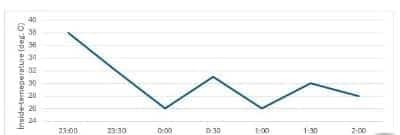
1. Question:
How many times the AC must have been turned off between 11:01 pm and 1:59 am?
Options:
2
cannot be determined
1
0
2. Question:
What was the temperature outside, in degrees Celsius, at 1 am?
3. Question:
What was the temperature outside, in degrees Celsius, at 9 pm?
4. Question:
What best can be concluded about the number of times the AC must have either been turned on or the AC temperature setting been altered between 11:01 pm and 1:59 am?
Options:
More than 3
Exactly 2
Exactly 3
Either 2 or 3
5. Question:
What was the maximum difference between the temperature outside and inside temperature, in degrees Celsius, between 11:01 pm and 1:59 am?
Also Read:
DILR questions in CAT test your ability to interpret data and apply logical reasoning to solve problems. These questions often involve tables, graphs, puzzles, and arrangements. Focus on identifying easy sets, and managing time efficiently to build accuracy and speed.
1. Carefully analyse the data presented in charts or tables before attempting questions.
Before diving into calculations, take a moment to examine the data provided thoroughly. Understand the type of chart (bar, pie, line graph, table, etc.) and what information it conveys. Identify units, periods, categories, and any trends visible. This initial overview helps prevent mistakes and ensures you interpret the data correctly.
2. Identify key trends, ratios, and percentages to simplify calculations.
Spotting important patterns, ratios, or percentage changes in the data can simplify complex problems. Instead of solving every detail, focus on key relationships between data points. For example, calculating percentage increases or decreases or finding ratios between categories often leads to quicker solutions.
3. Use approximation to save time without compromising accuracy.
Data Interpretation questions often allow for rounding off numbers to save time. Use approximations where precise calculations are not required, especially with large or complex figures. This strategy speeds up solving while maintaining sufficient accuracy to choose the correct option. However, avoid over-approximating, which can lead to errors. Regular practice will help develop a sense of when and how much to approximate effectively.
4. Break complex data sets into smaller, manageable parts.
When faced with large or complicated data tables, divide the information into smaller sections. Focus on one segment at a time instead of trying to analyse everything simultaneously. This reduces cognitive overload and helps in better understanding. Answer questions related to each segment before combining insights to solve bigger problems.
5. Avoid unnecessary calculations by focusing on relevant information.
Many DI questions contain extra data that isn’t needed to answer the specific query. Identify and ignore irrelevant information to save time. Carefully read the question to understand what exactly is being asked. This prevents wasting effort on needless calculations.
6. Practice regularly with diverse DI sets to improve speed and accuracy.
Consistent practice is essential to mastering DI questions. Work on various question types, including tables, graphs, charts, and caselets. Exposure to different data formats builds familiarity and enhances your ability to interpret data quickly. Regular practice also helps in developing shortcuts, spotting patterns, and reducing calculation errors.
Read on to know about the major tips to solve CAT Logical Reasoning Questions:
1. Read the entire set carefully before attempting questions
Start by thoroughly reading the complete question set. Understand the scenario, constraints, and what is being asked before jumping into answers. This ensures you don’t miss any vital details. Logical Reasoning questions often contain hidden conditions or subtle clues, so reading carefully helps in setting a solid foundation for solving. Avoid assumptions not supported by the given data to maintain accuracy and logical consistency throughout.
2. Organise the data using diagrams or tables
Converting textual information into structured formats like tables, matrices, or diagrams makes it easier to visualise relationships and constraints. Logical puzzles, seating arrangements, or grouping problems become more manageable when you sketch the scenario. This visual approach helps track fixed and variable positions, reduces confusion, and speeds up the solving process. A neat structure also reduces errors and makes it easier to revisit the logic if needed.
3. Start with the definite information first
Always begin solving with the most concrete, fixed pieces of data. Establishing the known facts first helps in narrowing down possibilities for the unknowns. Once you place the definite elements, it becomes easier to apply conditions and make logical deductions. Trying to start with assumptions or unclear clues leads to confusion.
4. Eliminate impossible scenarios through logic
Use the process of elimination to discard options or arrangements that violate given conditions. Logical Reasoning is often about narrowing down choices using constraints rather than solving linearly. Carefully testing each option against all rules and eliminating inconsistent ones helps you arrive at the correct answer faster. This technique also minimises time spent on trial and error and boosts accuracy, especially in complex LR sets with multiple variables.
5. Avoid spending too much time on one set
Time management is key in CAT. If a Logical Reasoning set seems too complex or time-consuming, move on and return later if time allows. Getting stuck on one set can affect your chances of attempting other easier questions. Prioritise solvable sets and maximise your score through smart selection. Practising CAT mock tests will help build the judgment to decide when to move on or stay with a set.
6. Practice consistently with past CAT LR questions
The best way to master Logical Reasoning is consistent practice using past CAT papers and mocks. This helps in understanding the pattern and difficulty level of CAT LR questions. Regular exposure to different types of reasoning problems, arrangements, groupings, and puzzles. It also builds speed, logic, and accuracy. Review your solutions after each practice to understand mistakes and improve. Over time, this habit strengthens your approach and boosts confidence during the actual exam.
Preparing for the DILR section in CAT 2026 requires a smart and focused approach. This section tests analytical thinking and decision-making under pressure. Here are the major preparation tips for CAT DILR 2026:
Start by gaining complete clarity on the CAT DILR exam pattern and syllabus. The section typically includes four sets with 5–6 questions each, covering topics like bar graphs, pie charts, seating arrangements, puzzles, and caselets. Knowing what to expect helps you prioritise topics and tailor your preparation accordingly.
Before attempting advanced-level questions, ensure you are comfortable with basic data interpretation and logical reasoning concepts. Learn to identify patterns, understand relationships, and calculate quickly. Solid foundational skills will help you approach complex sets with better confidence and minimise errors during the exam.
Regularly attempt sectional tests with a strict timer to simulate the exam environment. Focus on accuracy and speed while solving. Reviewing your performance after each test helps you identify weak areas and adjust your strategy. Over time, this improves your ability to handle pressure and manage time effectively.
Studying previous year's CAT DILR questions is one of the best ways to understand the difficulty level and question patterns. Practice sets from the last 5–7 years to recognise recurring types of problems. This helps develop familiarity and better question selection strategies during the actual exam.
Not all DILR sets are of equal difficulty. Learn to quickly scan all sets at the beginning of the section and identify the easiest ones first. Prioritising easy questions boosts confidence and saves time. Avoid spending too long on one set, and move on if stuck.
The candidates must refer to the DILR Ebooks curated by Careers360. These ebooks are suitable CAT 2026 study materials along with previous year's questions and sample papers. Go through the table below to get the download links for Logical Reasoning and Data Interpretation ebooks.
Mastering DILR Questions with Expert Solutions | |
CAT 2026 Exam's High Scoring Chapters and Topics | |
Mastering CAT Exam: VARC, DILR, and Quant MCQs & Weightage | |
CAT 2026 Mastery: Chapter-wise MCQs for Success for VARC, DILR, Quant | |
CAT 2026 Quantitative Aptitude Questions with Answers | |
CAT DILR Questions with Solution, Download LRDI Questions for CAT |
Frequently Asked Questions (FAQs)
“How to Prepare for DILR for CAT” by Arun Sharma is widely recommended. It includes conceptual clarity, solved examples, and practice sets suited for CAT-level preparation.
Begin by understanding the exam pattern, solving basic puzzles and data sets, and gradually move to CAT-level questions. Practice daily and analyse your mistakes for improvement.
Yes, CAT DILR is considered tough due to unpredictable question patterns and time pressure. With regular practice, strategic set selection, and strong reasoning skills, it becomes manageable.
Focus on accuracy, solve at least two sets correctly in mock tests, and practice the previous year's CAT DILR questions. Prioritise smart set selection and time management.
A score of 40–45 out of 66 is considered good in DILR and can fetch a 95–99 percentile, depending on the difficulty level of the section.
The important tips to master DI LR of CAT syllabus 2024 are provided in length in the article.
Candidates shall start their CAT preparation for 2024 by first getting familiar with the CAT exam syllabus and CAT paper pattern.
The preparation of LR DI CAT requires the incorporation of the right strategy and lots of practise. Other important tips include time management, solving mock test, analysing weaknesses and gaps.
To improve your hands at DILR questions of CAT, don’t just focus on practicing more and more questions. Instead, focus on the right approach to be used for solving the questions.

On Question asked by student community
Hello CAT Aspirant!
If you mean the CAT ( Common Admission Test) EWS certificate, the important point is whether the certificate is valid and issued in the prescribed format, rather than simply the language used on it.
Yes, a Hindi EWS certificate can generally be accepted for CAT, provided it
If you have already received your final MA result and have technically completed the degree , but you are only waiting for the revaluation outcome, you would generally be considered a graduate rather than someone whose master's degree is still completely in progress. However, CAT has specific instructions about qualification
If you mean CAT (Common Admission Test) preparation, you can practise with previous-year CAT papers. IIM has a collection of CAT papers from 2017 to 2025, covering VARC, DILR and Quant across different slots, along with solutions and explanations. Solving the recent papers first can help you understand the current
Hello Student,
Yes, you can apply for CAT with an EWS certificate issued in Hindi, provided it is issued by the competent authority and follows the required format. However, CAT applicants need a Central-level EWS certificate, not merely a state-level EWS certificate. Since you are from Uttar Pradesh, ensure your
Hey there,
If you mean your MBA counselling seat-allotment letter, the exact download process depends on the counselling authority.
Usually:
Directions for question:
The bar-graph given below shows the foreign exchange reserves of Nepal (in million Rupees) from 2014 to 2021. Answer the following questions based on the graph :

Question:
What was the percentage increase (rounded to the nearest integer, if deemed necessary) in the foreign exchange reserves in

Globally Recognized by AACSB (US) & AMBA (UK) | 18 LPA Avg. CTC for PGPM 2026
75+ years of legacy | #1 Entrance Exam | Score accepted by 250+ BSchools
6-Hour Masterclass to help you score 99+ percentile in CAT 2026
Test centres are available in 70+ cities across India | 75,000+ aspirants apply for the NMAT exam | Accepted by 58+ institutions like NMIMS, KJSIM, ISB, SPJIMR and Great Lakes.
Registration Start: 3 August 2026 | Last Date to Apply: 15 September 2026 (till 5 PM)
AACSB Accredited | 40 LPA-Highest CTC | Scholarships worth 10 CR