Great Lakes - PGDM & PGPM Admissions 2027
Globally Recognized by AACSB (US) & AMBA (UK) | 18 LPA Avg. CTC for PGPM 2026


The CAT exam for MBA admissions in 2025-2027 will be conducted on November 24, 2024. Here is the plan for day 30 of Careers360's 60-day CAT 2024 preparation guide. This will help you study for the CAT exam.

The major focus of this article is the problem of Trains, Relative Speed aptitude questions, Boat and Stream questions, Decision Making (part 2), and direct and indirect VARC questions. Students will gain knowledge of various sections, comprehend ideas, and experiment with methods for answering both direct and indirect multiple-choice questions.
Important Concept/Formula Used in Relative Speed aptitude questions and problems on trains
Problems on trains: Trains (Length L1 and L2) Approaching each other with velocities v1 and v2.
Time taken to Cross each other = (L1+L2)/(v1+v2)
Trains (Length L1 and L2) moving in the same direction with velocities v1 and v2. (v1 > v2)
Time taken to overtake = (L1+L2)/(V1-V2)
Concept of upstream:
Speed of boat in upstream = Vu = v – u
v = speed of boat in still water
u = speed of river/flow/current
Concept of downstream
Speed of boat in downstream = Vu = v + u
CAT Exam:
Previous Year CAT Questions On Time, Speed and Distance (CAT questions on Boats and Streams)
Train Aptitude Questions
Q1. Train T leaves station X for station Y at 3 pm. Train S, travelling at three-quarters of the speed of T, leaves Y for X at 4 pm. The two trains pass each other at station Z, where the distance between X and Z is three-fifths of that between X and Y. How many hours does train T take for its journey from X to Y? [TITA: CAT 2018]
Relative Speed Aptitude Questions with Solution:
Let the total distance between X and Y = 5a, therefore the distance between X and Z = 3a & between Y and Z = 2a.
The ratio of time taken by train T and train S to reach Z from their respective Station = (3a/v: 2a/3v/4 = 9: 8) where v is the velocity of train T.
Let time taken by train T is 9y, then the time taken by train S will be 8y.
Therefore, (9y -1) = 8y
⇒ y = 1
so, time taken by train T to cover 3a = 9 hour
so, time taken by train T to cover XY (5a) = 5/3 x 9 = 15 hour
Boats and Streams Aptitude Problems
Q2. A man travels by motor boat down a river to his office and back. With the speed of the river unchanged, if he doubles the speed of his motorboat, then his total travel time gets reduced by 75%. The ratio of the original speed of the motor boat to the speed of the river is [CAT 2017]
6: 2
7: 2
25: 3
3: 2
Boat and Stream Questions With Solution: [B]
Let the speed of the boat in still water and the speed of the river be v and u respectively. D is the width of the river.
So, D/v+u+ D/v-u = Time taken (with original speed of motor boat)
and D/2v+u+ D/2v-u = Time taken (with the double speed of motor boat)
According to the question, travel time is reduced by 75% which means new time is ¼ of old time.
So, 4D/2v+u+ 4D/2v-u= D/v+u+ D/v-u
On solving, we get v: u = 7: 2
CAT entrance exam: Prerequisite for quantitative aptitude for CAT questions:
Ratios, Proportion and variations
Basics of Time, Speed and distance
CAT Exam Important Topic: Strategy to Prepare “Basics of Time, speed and Distance (Trains and Boats)” and problems on trains
a km/hr= (a x 5/18) m/s
Time taken by a train of length L to cross a man or pole is equal to L/v.
Time taken by a train of length L to cross a stationary object of length x is equal to (L + x)/v.
If the two objects start from A and B with speeds u and v respectively, and after crossing each other take a and b hours to reach B and A respectively, then u: v = √b: √a.
Divide questions topic-wise and practice different problems based on CAT Previous years questions.
CAT study material: References to Study (Theory)
How to Prepare for Quantitative Aptitude for CAT by Arun Sharma (7th Edition)
For Problems on Trains: Mission CAT (YouTube, Link: https://www.youtube.com/watch?v=v-383fMptOI)
For Boats and Stream: Rodha (YouTube) Link: https://www.youtube.com/watch?v=vx3DfHuuY6Y
CAT study material: References to Practice Problems on Trains, Boat and Stream Problems
Quantitative Aptitude for the CAT – Sarvesh Verma.
Trains: AlphaNumeric (YouTube) (Link: https://www.youtube.com/watch?v=n0TMtPq5NlQ)
CAT Sample Papers and previous years questions.
CAT 2024 Syllabus Topic: Strategy to prepare “Decision Making” (Part-2)
Sample Questions Based on the CAT/XAT Exam:
Comprehension:
A device classifies numbers according to the following criteria. The number must have
seven digits.
at least two prime digits.
perfect squares as the first and the last digits.
an even digit as the middle digit. If the number satisfies criteria (A), (B), (C) and (D) then the number is classified as a Superior number.
If a number is a superior number and the digits are in increasing order from left to right according to the value, then the number is classified as an impressive number.
If the number satisfies criteria (A), (B) and (D) but not (C), but the first and last digits are even, then the number is classified as a Mutual number.
If the number satisfies criteria (A) (B) and (C) but not (D) but all the digits are odd, then the number is classified as a Classic number.
If the number does not fall under any of the above-mentioned classifications, then the number is classified as a Garbage number. Based on the above criteria, decide which number should be classified in which of the above-mentioned classification.
Mark your answer choice as
(A), if the number is classified as a Superior number.
(B), if the number is classified as an impressive number.
(C), if the number is classified as a Mutual number.
(D), if the number is classified as a Classic number.
(E), if the number is classified as a Garbage number.
Classify the following number as mentioned above.
1778459
4276891
1367574
9632578
4556666
4368579
1366789
9517531
1573934
964374
Solution:
Tip: Summarize the details given in the form of table:
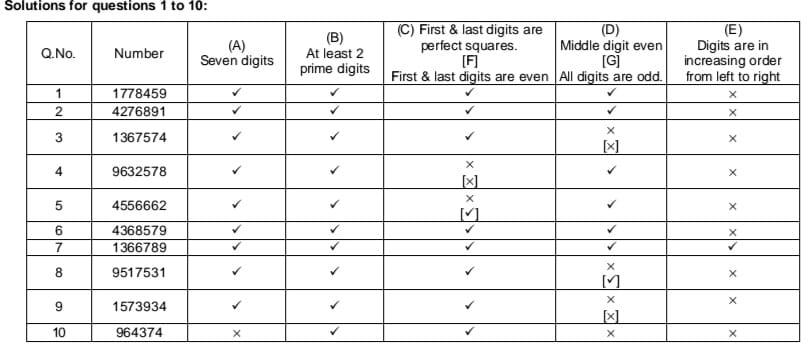
Ans
A
A
E
E
C
A
B
D
E
E
CAT Entrance Exam: Prerequisite
Analytical Skills
Decision Making: Concepts
Tips and Tricks for CAT
Practice XAT Sample Papers.
Practice XAT Previous Years Papers.
Do not waste much time on it if preparing for CAT.
Much important for XAT Exam.
References to CAT Study (Theory)
Verbal and Non- Verbal Reasoning by B S Sijwali
CAT LRDI by Nishit K Sinha
References to Practice
Verbal and Non-Verbal Reasoning by R S Agrawal.
CAT/XAT Previous years Papers and Sample Papers.
CAT Exam Important Topic: Strategy to Prepare “Direct and Indirect Speech” for CAT-2024
CAT Important Concepts
Changes from direct to indirect require
Changes in Tense
Changes in Person and Pronouns
Changes in Time Phrases
CAT Previous Years' MCQs on Direct and Indirect:
Question 1: Direct: He said, “Will you come for the meeting?”
Indirect:
He asked them whether he would come for the meeting.
He asked them that he will come for the meeting.
He said to them whether he will come for the meeting.
None of these
Ans: A
Explanation: Future tense changes to present conditional.
Question 2: Direct: She said, “I have baked a cake.”
Indirect:
She said that she baked a bake.
She said that she had baked a cake.
She said whether she had baked a cake.
None of these.
Ans: B
Explanation: Present perfect changes to past perfect.
CAT 2024:Prerequisite
The basic idea of Tenses.
Knowledge of subject-verb and object.
Tips and Tricks for CAT Exam
Recognize the structure carefully.
All inverted commas or quotation marks are omitted and the sentence ends with a full stop.
Conversion rules:
Simple Present Changes to Simple Past.
Present Continuous Changes to Past Continuous.
Present Perfect Changes to Past Perfect
Simple Past Changes to Past Perfect
Past Continuous Changes to Past Perfect Continuous
Future Changes to Present Conditional
Future Continuous Changes to Conditional Continuous
Changes in Modals:
Can changes into Could, May changes into Might, Must changes into Had to/ would have to.
Modals that DO NOT Change: Would, Could, Might, Should, Ought to.
Practice questions
CAT exam: References to Study (Theory)
Advanced English grammar by Martin Hewings
https://www.wallstreetenglish.com/exercises/direct-and-indirect-speech-exercises
CAT exam: References to Study (Practice)
How to Prepare for Verbal Ability & Reading Comprehension for CAT by Meenakshi Upadhyay and Arun Sharma (9th Edition)
CAT Previous years Papers and Sample Papers.
CAT Quantitative Aptitude Questions with Answers PDF | CAT 2024 GD PI Preparation: Experts and Toppers Tips |
Practice and remain focused; Day 32 will be posted tomorrow.
Frequently Asked Questions (FAQs)
Relative speed lets you understand how quickly one thing moves in comparison to another. If two items are moving in the same direction, subtract their speeds. If they go in different directions, add their speeds.
Put the following formula to use:
Where v1 > v2, time = (L1 + L2) / (v1 - v2).
The formula used to determine the time taken is:
L1 and L2 = the train lengths
v1 and v2=the train speeds
Time = (L1 + L2) / (v1 + v2)
Train problems include questions related to train speed, distance, and travel time. To answer these issues, apply the formula Distance = Speed × Time.
Direct VARC questions gather basic information from an article, while indirect questions demand you determine the meaning or comprehend the author's intention. Both types need a thorough study of the passage.
Relative speed lets you understand how quickly one thing moves in comparison to another. If two items are moving in the same direction, subtract their speeds. If they go in different directions, add their speeds.
Put the following formula to use:
Where v1 > v2, time = (L1 + L2) / (v1 - v2).
The formula used to determine the time taken is:
L1 and L2 = the train lengths
v1 and v2=the train speeds
Time = (L1 + L2) / (v1 + v2)
Train problems include questions related to train speed, distance, and travel time. To answer these issues, apply the formula Distance = Speed × Time.
Direct VARC questions gather basic information from an article, while indirect questions demand you determine the meaning or comprehend the author's intention. Both types need a thorough study of the passage.

On Question asked by student community
If by B-category you mean management/private quota MBBS seats, the cutoff is very different from government-quota MBBS.
In Tamil Nadu, management-quota MBBS seats are available in self-financing/private medical colleges through the state counselling process. The closing rank varies significantly between colleges and counselling rounds. The 2025 counselling data shows that
Hello Student,
With a CAT 2025 percentile of 98.25, you have a good chance of receiving calls from several IIMs, particularly newer IIMs. However, IIM Ahmedabad , Bangalore , Calcutta , and Lucknow generally require higher percentiles for General-category candidates. Calls also depend on sectional percentiles, academics, work experience, and
Hello Aspirant,
Yes, you can access CAT preparation resources, including mock tests, practice questions, previous-year papers, and study material. Explore the CAT preparation resources and test series using the link below:
https://bschool.careers360.com/download/ebooks-and-sample-papers?exam=45
Hope this Helps!
Hello CAT Aspirant!
If you mean the CAT ( Common Admission Test) EWS certificate, the important point is whether the certificate is valid and issued in the prescribed format, rather than simply the language used on it.
Yes, a Hindi EWS certificate can generally be accepted for CAT, provided it
Directions for question:
The bar-graph given below shows the foreign exchange reserves of Nepal (in million Rupees) from 2014 to 2021. Answer the following questions based on the graph :

Question:
What was the percentage increase (rounded to the nearest integer, if deemed necessary) in the foreign exchange reserves in

Globally Recognized by AACSB (US) & AMBA (UK) | 18 LPA Avg. CTC for PGPM 2026
75+ years of legacy | #1 Entrance Exam | Score accepted by 250+ BSchools
6-Hour Masterclass to help you score 99+ percentile in CAT 2026
AACSB Accredited | 40 LPA-Highest CTC | Scholarships worth 10 CR
400+ Recruiters | Highest CTC 25 LPA | Average CTC 8 LPA | 92% Placements in 2025 | Ranked as Platinum Institute | Awarded Best Business School of the Year
Among top 6% B-Schools globally to be accredited by AACSB | Highest Package-35 LPA