Dolphin PG Institute BBA Admissions 2026
10000+ Alumni across the globe | Scholarships available


Choosing the best books for BUMAT 2027 preparation can help candidates build strong fundamentals and practise the types of questions asked in the exam. The BUMAT test covers the topics, namely Numerical Aptitude, Reasoning/Logical Aptitude, Verbal Ability, and Reading Comprehension. As per the latest pattern of BUMAT 2026, the exam will consist of 200 multiple-choice questions with 200 marks. Students will have to attempt the questions in 150 minutes, and there will be no negative marking.
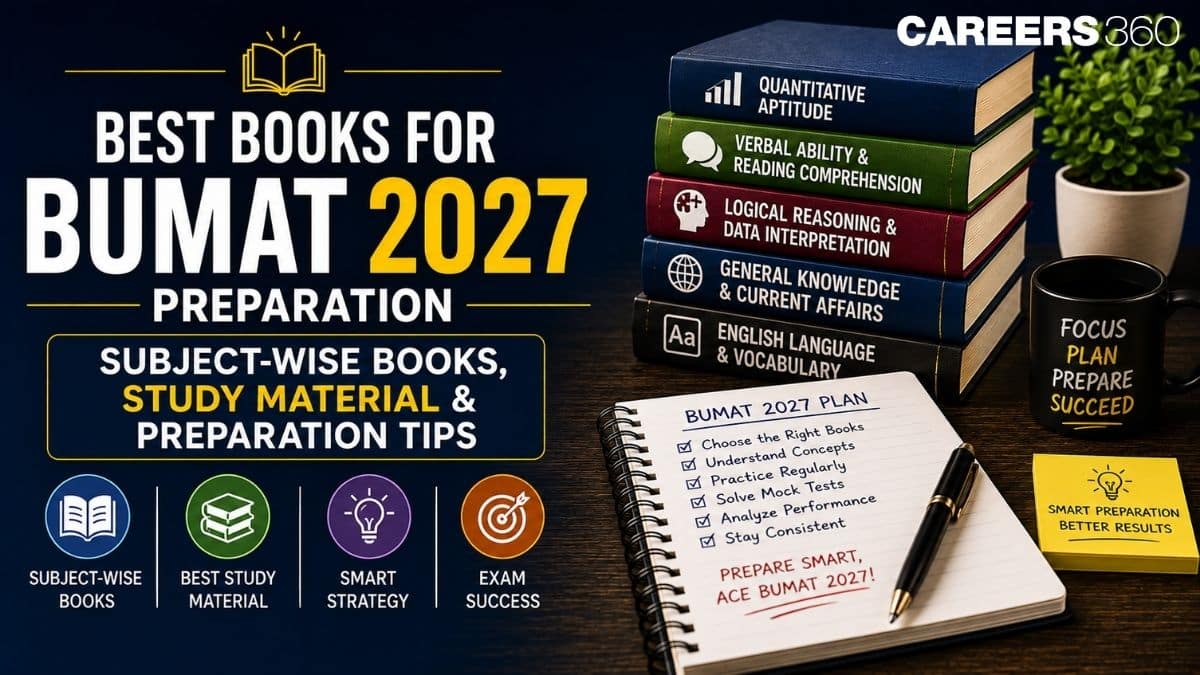
The BUMAT syllabus is divided into four sections: Numerical Aptitude, Reasoning/Logical Aptitude, Verbal Ability, and Reading Comprehension. The BUMAT exam pattern shows that the exam consists of 60 questions each for Logical and Quantitative Aptitude, and 20 questions for Reading Comprehension.
BUMAT Section | Key Topics to Prepare |
Numerical Aptitude | Number System, HCF & LCM, Percentages, Ratio & Proportion, Averages, Profit & Loss, Simple Interest & Compound Interest, Time & Work, Time-Speed-Distance, Algebra, Linear Equations, Geometry, Probability, Data Interpretation, Data Sufficiency |
Reasoning / Logical Aptitude | Number Series, Letter Series, Analogies, Classification, Coding-Decoding, Blood Relations, Direction Sense, Syllogisms, Venn Diagrams, Calendars, Clocks, Arrangements, Logical Deductions, Data Interpretation |
Verbal Ability | Vocabulary, Synonyms & Antonyms, Grammar, Sentence Correction, Fill in the Blanks, Idioms & Phrases, One-Word Substitution, Para Jumbles, Sentence Completion, Word Usage |
Reading Comprehension | Main Idea, Supporting Details, Inference-Based Questions, Author's Tone, Vocabulary in Context, Passage-Based Questions, Logical Interpretation |
*Keep a check on the official website for any updates and notifications.
Preparation Priority: First, one should start with Arithmetic and basics, learn grammar and work on vocabulary and reading comprehension skills. Once the basics are clear, practice individual sections with time limits and take up the BUMAT mock test series.
Instead of referring to multiple books, it is always a good idea to take one reliable reference book for each section and complement your preparation with BUMAT model papers/mock tests and practice material.
BUMAT Section | Recommended Book | Best For |
Numerical Aptitude | Quantitative Aptitude for Competitive Examinations - R.S. Aggarwal | Concepts + practice |
Numerical Aptitude | Quantitative Aptitude - Abhijit Guha | Additional practice |
Reasoning/Logical Aptitude | A Modern Approach to Logical Reasoning - R.S. Aggarwal | Reasoning concepts |
Reasoning/Logical Aptitude | How to Crack Test of Reasoning - Arihant | Practice questions |
Verbal Ability | Objective General English - S.P. Bakshi | Grammar + verbal practice |
Vocabulary | Word Power Made Easy - Norman Lewis | Vocabulary building |
English Grammar | High School English Grammar and Composition - Wren & Martin | Grammar fundamentals |
Reading Comprehension | Proficiency in Reading Comprehension - Arihant | RC practice |
Numerical Aptitude carries 60 questions in the latest official pattern, making it one of the most important sections. The focus should be on arithmetic, algebra, number-based concepts, data interpretation and other aptitude topics.
This is a useful primary resource for candidates who need to strengthen their fundamentals and practise a large number of objective questions. Start with basic exercises before moving to timed sets.
Use this as an additional practice resource once your fundamentals are clear. It is better to complete one book thoroughly than to switch between several Quant books.
The official BUMAT pattern allocates 60 questions to Logical Reasoning/Logical Aptitude. Candidates should therefore practise common reasoning patterns regularly rather than relying only on theoretical preparation.
A practical choice for learning different reasoning question types and developing familiarity with standard patterns.
Use this for additional practice after learning the fundamentals. Give special attention to questions involving series, arrangements, coding-decoding, blood relations and logical deductions.
Verbal Ability also accounts for 60 questions, so English preparation should begin early rather than being treated as a final-stage subject.
Useful for grammar, vocabulary and objective-type practice. It can work as a structured resource for candidates who need to strengthen their English fundamentals.
A popular resource for systematic vocabulary building. Complete the exercises and revise difficult words regularly instead of trying to memorise large word lists at once.
This can be particularly useful for students who struggle with basic grammar. Use it as a concept and reference book alongside objective question practice.
Reading Comprehension has 20 questions in the latest official pattern. Preparation should focus on understanding passages quickly, identifying the central idea and answering inference-based questions accurately.
Use this book to practice RC. Start with short passages and then move on to longer ones while taking note of your reading and solving time.
A beginner does not need to purchase every recommended book. A focused combination is more practical.
Preparation Level | Suggested Combination |
Beginner | BBA entrance guide + R.S. Aggarwal Quant + R.S. Aggarwal Reasoning |
Weak in English | Wren & Martin + Word Power Made Easy + objective English practice |
Strong in Concepts | One primary book per section + sectional tests |
Advanced Stage | Selected books + mock tests + sample/previous papers |
Last 30 Days | Revision notes + targeted practice + full-length mocks |
Books are useful only when they are converted into targeted practice. With 200 questions to be attempted in 150 minutes in the latest pattern, candidates need to develop speed without sacrificing accuracy.
Do not randomly solve hundreds of questions. Divide your practice according to topics.
For example:
Numerical Aptitude: percentages, averages, ratios, profit and loss, time and work
Reasoning: series, coding-decoding, arrangements, directions and relationships
Verbal Ability: grammar, vocabulary, sentence correction and verbal questions
Reading Comprehension: main idea, inference, tone and vocabulary in context
Begin with untimed practice to understand the method. Once your accuracy becomes consistent, introduce time limits.
A useful progression is:
Concept practice → topic test → sectional test → mixed test → full-length mock
Do not practise only easy questions. Combine straightforward, moderate and challenging questions so that you learn to identify which questions deserve immediate attempts and which should be skipped temporarily.
After every practice session, record:
Conceptual mistakes
Calculation mistakes
Questions that took too long
Questions guessed incorrectly
Topics requiring revision
Revisiting this log can be more valuable than repeatedly solving questions you already answer correctly.
If percentages repeatedly cause mistakes, spend another practice session specifically on percentages. Do not simply take another full mock and hope the problem disappears.
Start sectional tests after completing the fundamentals of the section. Take full-length mocks when you have done all the important topics of the syllabus.
After every mock, do an analysis of the test taken.
Check | What to Identify |
Accuracy | Which section has the most errors? |
Speed | Which questions consumed excessive time? |
Concepts | Which topics need revision? |
Attempts | Did you avoid or over-attempt questions? |
Improvement | Did the same mistakes recur? |
Because the latest official pattern has no negative marking, candidates should also develop an attempt strategy suited to the actual marking scheme. [Official: https://www.bvuniversity.edu.in/entrance-exam]
Avoid common mistakes such as using too many books, studying without a clear strategy, skipping practice questions, and failing to revise important concepts. A focused approach to BUMAT books can help you make your preparation more structured and productive.
More books do not automatically mean better BUMAT preparation. Select limited resources and complete them properly.
Understanding a concept is only the first step. BUMAT requires objective-question practice under time pressure.
Although RC has fewer questions than the other sections, it should not be neglected because it tests both comprehension and speed.
A mock score alone does not show how to improve. Analyse every wrong and time-consuming question before taking the next test.

Among top 100 Universities Globally in the Times Higher Education (THE) Interdisciplinary Science Rankings 2026
Recognized as Category-1 Deemed to be University by UGC | 41,000 + Alumni Imprints Globally | Students from over 20+ countries
#36 in NIRF | 100% Placement, Get Upto 100% Scholarships | Spot Admissions via CUET | Last Date to Apply- 10th Sept
NAAC Accredited | #7 by IIRF in Uttar Pradesh | Scholarships Available
Applications fee waiver for all prgrammes | B.Sc (Hons) Admissions 2026 Now Open | Ranked Among the Top 100 Universities in the World by QS World University Rankings 2025
India's youngest NAAC A++ accredited University | NIRF rank band 151-200 | 2200 Recruiters | 45.98 Lakhs Highest Package