
Search Colleges, Exams, Schools & more


Login
CAT Geometric Centres of a Triangle - Practice Questions & MCQ
Edited By admin | Updated on Oct 04, 2023 04:20 PM | #CAT
Quick Facts
-

5 Questions around this concept.
Solve by difficulty
 EASY
EASYIn an equilateral triangle whose sides are 10 cm, then the ratio of the area of circumcircle and incircle is:
Concepts Covered - 1
Geometric Centres of a Triangle
Circumcircle: There here is a unique circle passing through the three vertices A, B and C of the triangle. This circle is called the circumcircle of the ∆ ABC. Its center and radius are called respectively the circumcentre and the circumradius of the triangle.
Circum-centre: The point of intersection of the perpendicular bisectors of the sides of a triangle is called its circumcenter. The circumcenter is equidistant from all the vertices of the triangle.
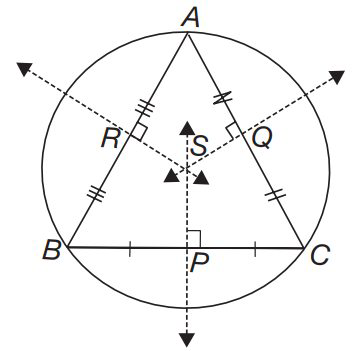
Let a, b, and c denote the triangle's three sides, and let A denote the area of the triangle. Then, the measure of the circumradius (R) of the triangle is given by .
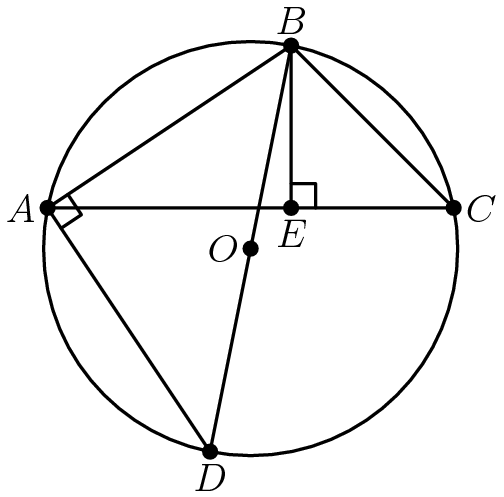
Let AB = c, BC = a, AC = b, BE = h, and BO = R. We know that is a right angle because BD is the diameter. Also,
because they both subtend arc AB. Therefore,
by AA similarity.
So we have
And as you remember that area of the triangle [ABC] =
Put the value of h in (1), we get
and then simplifying to get
Circumradius of Right Angle Triangle
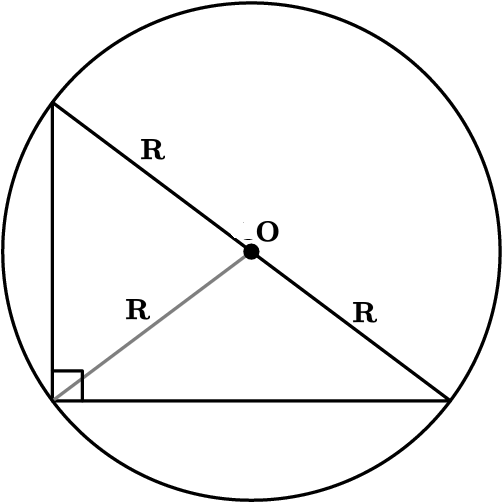
The hypotenuse of the triangle is the diameter of its circumcircle, and the circumcenter is its midpoint, so the circumradius is equal to half of the hypotenuse of the right triangle.
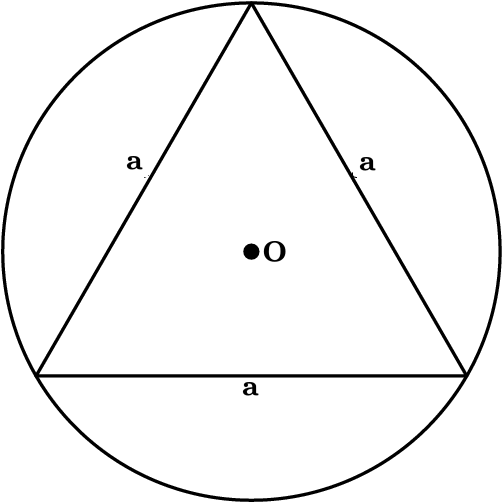
Circumradius of Equilateral Angle Triangle
where a is the length of a side of the triangle.
Incircle: The circle inscribed in a triangle is the largest circle contained in the triangle; it touches (or tangent to) the three sides of the triangle. The center of the incircle is called the incenter and the radius of the incircle is called inradius and it is denoted by 'r'.
Incenter: The angle bisectors of the triangle are concurrent and the point of concurrence is called the in-center and is usually denoted by I. I is equidistant from the sides of the triangle.
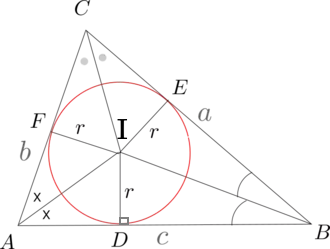
Proof:
Add in the incircle and drop the altitudes from the incenter to the sides of the triangle. Also, draw the lines AI, BI and.CI After this AB, AC, and BC are the bases of , and
respectively. But they all have the same height (the inradius), So,
Since, ID = IF = IE = r = inradius and let ½(a + b + c) = s = semiperimeter of triangle, then we get
Inradius of Right Angle Triangle
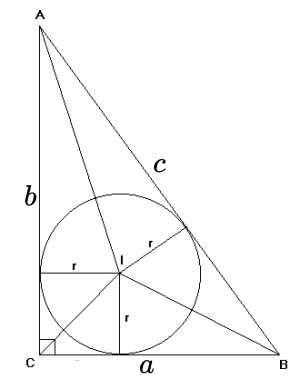
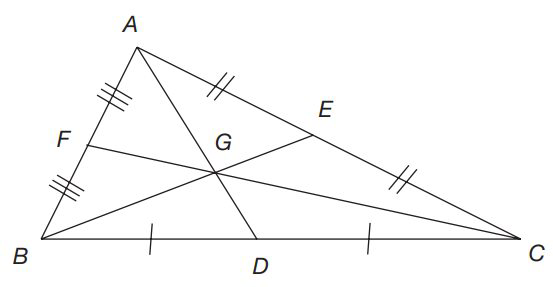
Centroid: The medians of a triangle are concurrent and the point of concurrence of the medians of a triangle is called the centroid and it is usually denoted by G. The centroid divides each of the medians in the ratio 2 : 1, i.e., in the figure given below, AG : GD = BG : GE = CG : GF = 2 : 1.
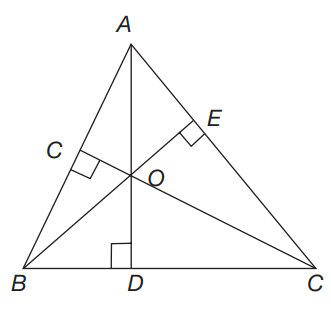
Ortho-centre: The altitudes of the triangle are concurrent and the point of concurrence of the altitudes of a triangle is called ortho-centre and is usually denoted by O.
"Stay in the loop. Receive exam news, study resources, and expert advice!"
Get Answer to all your questions

MBA/PGDM Admissions OPEN
Ranked among top 10 B-Schools in India by multiple publications | Top Recruiters-Google, MicKinsey, Amazon, BCG & many more.
GITAM University Admissions 2026
ApplyAICTE Approved | NAAC A++ | Category 1 University by MHRD | Highest CTC 1.4 Cr LPA from Amazon | Application Deadline: 29th May'26
PP Savani University MBA Admissions 2026
ApplyMBA @ P P Savani University | NAAC A+ Grade | 100% Placement Assistance | Apply Now
N. L. Dalmia Institute of Management, PGDM Admissions 2026
ApplyAICTE Approved | NBA Accredited | NAAC A+(2nd Cycle) Accredited. Highest CTC: 24 LPA | Average CTC: 11.17 LPA
Siva Sivani Institute of Management PGDM Admissions 2026
Apply98.74% Students Placed | 180+ Recruiters on Campus | Average CTC 7.25 LPA
Sharda University Admissions 2026
ApplyNorth India's Largest Educational Group | NIRF Ranked 87 | NAAC A+ Grade | Highest Package 1.6 Cr | Avail 50% Waiver on Application Fee | Last Date: 31st May'26